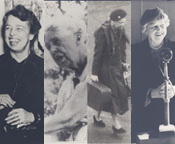
The Eleanor Roosevelt Papers Project is a university-chartered research center associated with the Department of History of The George Washington University



Question: Why is Eleanor Roosevelt often called the "reluctant first lady?"
Answer:
![[picture: Dust jacket of Lorena Hickok's Eleanor Roosevelt: Reluctant First Lady]](../images/reluctanfirstlady.jpg) Eleanor
Roosevelt did not want to be first lady, and the press recognized
it. She had worked very hard to build her own career, develop
her own personal and professional circle, and loved teaching
at the Todhunter School.
Her earlier experiences in Washington, as an assistant secretary=s
wife and the president=s
niece, showed her how cold, calculating, and isolating life
could be in the nation=s
capital.
Eleanor
Roosevelt did not want to be first lady, and the press recognized
it. She had worked very hard to build her own career, develop
her own personal and professional circle, and loved teaching
at the Todhunter School.
Her earlier experiences in Washington, as an assistant secretary=s
wife and the president=s
niece, showed her how cold, calculating, and isolating life
could be in the nation=s
capital.
ER made news throughout the 1932 campaign when she told
the press that she planned to do more than serve as White
House hostess. On July 4th, the Associated Press declared
"Eleanor Roosevelt Would Scrap Outworn Social Traditions:
Can't Imagine Being Absorbed by Drawing Room Duties, Wife
of Nominee Declares." The Washington Star followed
suit, proclaiming that "Mrs. Roosevelt Would Scrap Outworn
Social Traditions." By October, the image of "Eleanor Roosevelt:
Tireless Worker" spilled across seven columns of a North
American News Alliance wire release.
ER spent election night in conflict. Although she "was
happy for my husband"
that evening, she felt "more deeply troubled" than her close
friends knew. She thought her husband's victory "meant the
end of any personal life of my own." She knew what would
be expected of her. "I had watched Mrs. Theodore Roosevelt
and had seen what it meant to be the wife of a president,
and I cannot say that I was pleased at the prospect." Her
career had given her a "certain amount of financial independence,"
which she "enjoyed" because she "had been able to do things
in which I was personally interested." She went to bed with
great "turmoil in my heart and mind" and the fear that "the
next few months were not to make any clearer what the road
ahead would be."
A week after the 1932 election, ER told
Lorena Hickok, the Associated Press reporter assigned
to cover her during the campaign, "I never wanted it even
though some people have said that my ambition for myself
drove him on . . . . I never wanted to be a President's
wife." Fearful that her qualified support for her husband
would be misunderstood, she clarified her stance: "For him,
of course, I'm glad - sincerely. I could not have wanted
it any other way. After all I'm a Democrat, too. Now I shall
have to work out my own salvation. I'm afraid it may be
a little difficult. I know what Washington is like. I've
lived there." (1)
ER admitted to Hickok that she would "curtail somewhat
her activities" but she refused to stop all
of them. Aware of the criticism her position
would provoke, she declared that she had no
choice but to continue. "I'll just have to go
on being myself, as much as I can. I'm just
not the sort of person who would be any good
at [any] job. I dare say I shall be criticized,
whatever I do."
Publicly, ER tried to reason with her critics, telling
an interviewer that she "really [was] not doing anything
that I haven't done for a long time. It's only Franklin's
position that has brought them to the attention of the people."
She pleaded for a few more weeks of freedom. "I shall drop
a good many things when we get to Washington. But . . .
we aren't in Washington yet. . . . Until March 4, I hope
to be permitted to enjoy the privileges accorded a private
citizen." But that did not happen. When ER entered the new
year doing "the things she had always done," Hickok reported, "the papers continued to carry stories about her.
And some people continued to criticize her. They just could
not get used to the idea of her being 'plain, ordinary Eleanor
Roosevelt.'"
The closer inauguration came, the more concerned she became.
Her aversion to a purely ceremonial role was so strong that
in the week before the inauguration she impetuously wrote
Marion Dickerman
and Nancy Cook that
she was contemplating divorcing FDR. She told Hickok, in
a quote for the record, that she "hated" having to resign
her teaching position at Todhunter, saying "I wonder if
you have any idea how I hate to do it."
(2)
Thirty years later, when Hickok wrote a biography
of ER, she titled it Eleanor Roosevelt:
Reluctant First Lady.
Notes:
Eleanor
Roosevelt did not want to be first lady, and the press recognized
it. She had worked very hard to build her own career, develop
her own personal and professional circle, and loved teaching
at the Todhunter School.
Her earlier experiences in Washington, as an assistant secretary=s
wife and the president=s
niece, showed her how cold, calculating, and isolating life
could be in the nation=s
capital.
ER made news throughout the 1932 campaign when she told the press that she planned to do more than serve as White House hostess. On July 4th, the Associated Press declared "Eleanor Roosevelt Would Scrap Outworn Social Traditions: Can't Imagine Being Absorbed by Drawing Room Duties, Wife of Nominee Declares." The Washington Star followed suit, proclaiming that "Mrs. Roosevelt Would Scrap Outworn Social Traditions." By October, the image of "Eleanor Roosevelt: Tireless Worker" spilled across seven columns of a North American News Alliance wire release.
ER spent election night in conflict. Although she "was happy for my husband" that evening, she felt "more deeply troubled" than her close friends knew. She thought her husband's victory "meant the end of any personal life of my own." She knew what would be expected of her. "I had watched Mrs. Theodore Roosevelt and had seen what it meant to be the wife of a president, and I cannot say that I was pleased at the prospect." Her career had given her a "certain amount of financial independence," which she "enjoyed" because she "had been able to do things in which I was personally interested." She went to bed with great "turmoil in my heart and mind" and the fear that "the next few months were not to make any clearer what the road ahead would be."
A week after the 1932 election, ER told Lorena Hickok, the Associated Press reporter assigned to cover her during the campaign, "I never wanted it even though some people have said that my ambition for myself drove him on . . . . I never wanted to be a President's wife." Fearful that her qualified support for her husband would be misunderstood, she clarified her stance: "For him, of course, I'm glad - sincerely. I could not have wanted it any other way. After all I'm a Democrat, too. Now I shall have to work out my own salvation. I'm afraid it may be a little difficult. I know what Washington is like. I've lived there." (1)
ER admitted to Hickok that she would "curtail somewhat her activities" but she refused to stop all of them. Aware of the criticism her position would provoke, she declared that she had no choice but to continue. "I'll just have to go on being myself, as much as I can. I'm just not the sort of person who would be any good at [any] job. I dare say I shall be criticized, whatever I do."
Publicly, ER tried to reason with her critics, telling an interviewer that she "really [was] not doing anything that I haven't done for a long time. It's only Franklin's position that has brought them to the attention of the people." She pleaded for a few more weeks of freedom. "I shall drop a good many things when we get to Washington. But . . . we aren't in Washington yet. . . . Until March 4, I hope to be permitted to enjoy the privileges accorded a private citizen." But that did not happen. When ER entered the new year doing "the things she had always done," Hickok reported, "the papers continued to carry stories about her. And some people continued to criticize her. They just could not get used to the idea of her being 'plain, ordinary Eleanor Roosevelt.'"
The closer inauguration came, the more concerned she became. Her aversion to a purely ceremonial role was so strong that in the week before the inauguration she impetuously wrote Marion Dickerman and Nancy Cook that she was contemplating divorcing FDR. She told Hickok, in a quote for the record, that she "hated" having to resign her teaching position at Todhunter, saying "I wonder if you have any idea how I hate to do it." (2)
Thirty years later, when Hickok wrote a biography
of ER, she titled it Eleanor Roosevelt:
Reluctant First Lady.