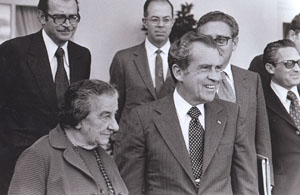
- the failure of U.S. intelligence to perceive the imminent
threat of war; according to the State Department's intelligence
chief, Ray Cline: "Our difficulty was partly that we
were brainwashed by the Israelis, who brainwashed themselves."
(document 63)
- the advance warnings of a possible Egyptian-Syrian attack
received by the Israelis and Kissinger's advice to Prime
Minister Gold Meir to avoid preemptive action (documents
7, 9, 10,
and 18)
- the initial state of confusion in the U.S. intelligence
community about the possibility of war (document
13)
- Kissinger's early decisions to provide military aid to
Israel (documents 18 and 21) and stay in touch with Arab
leaders, to maximize U.S. diplomatic influence (documents
20, 44, and 63)
- Kissinger's initial downplaying of Arab threats of an
oil embargo and production cuts (document
36A)
- Kissinger's "shock" at, and refusal to follow,
Nixon's instruction to establish a U.S.-Soviet condominium
to enforce a peace settlement (documents 47
and 48)
- the complete record of Kissinger's 20-22 October talks
with the Soviets and the Israelis on a United Nations Security
Council cease-fire resolution (documents 46,
49-50, 53-56)
- Kissinger's virtual green light for Israeli violations
of the UN cease-fire (documents 51
and 54)
- Brezhnev's use of the U.S.-Soviet hotline to protest Israeli
cease-fire violations and the entrapment of Egypt's Third
Army (documents 61A and B)
- Brezhnev's 24 October letter that prompted the U.S. Defcon
III nuclear alert (document 71)
- Kissinger's rage at West European governments, whom he
saw as acting like "jackals" and "hostile
powers," for not supporting U.S. policy (documents
63 and 75)
- tense meetings of NATO's North Atlantic Council where
U.S. Ambassador Donald Rumsfeld heard complaints about the
lack of advance notice of the U.S. alert (documents
79A and B)
- Kissinger's conviction that war had put the United States
in a "central position" in the Middle East while
the Soviets had been "defeated" (document
63)
- U.S.-Palestinian Liberation Organization contacts during
the war (document 78)
- the record of emotional conversations between Kissinger
and Meir over cease-fire arrangements (documents 91A
and B, 93A and B)
As significant as the new material is, highly important U.S.
documentation on the October War remains classified, especially
among the National Security Files in the Nixon Presidential
Materials Project. The withheld material includes intelligence
reports, back channel messages sent through CIA offices, and
a variety of other documents. Perhaps most important, almost
all of the transcripts of meetings of the Washington Special
Action Group (WSAG)--a special NSC sub-committee responsible
for handling crisis situations--remain classified even though
thirty years have passed. In addition, declassification work
at the Nixon Presidential Materials Project is short-staffed
and mandatory review requests take considerable time to process.
Thus, it may be some years before new archival information
on the October War becomes available. (Note 2)
The transcripts of Henry Kissinger's telephone conversations
("telcons") are an especially important classified
primary source on the October War. For years under Kissinger's
personal control, all of the telcons are now under review
at the National Archives and the Department of State. A new
book by Kissinger, Crisis, consists of transcripts
of his telephone calls during October 1973. (Note
3) This is a significant collection which elucidates key
developments during the war. Unfortunately, the documents
themselves are not available, only Kissinger's edited rendition
of them. Crisis is by no means a stand-alone account
of U.S. policy during the October War in part because it overlooks
events, such as Kissinger's meetings with the Israelis on
22 October that had critically important consequences for
the course of the fighting.
As useful as Kissinger's compilation is, the documents have
been edited by him as well as excised by the National Security
Council. A fuller picture of the October War may not be available
until the universe of Kissinger telcons is open for research.
Moreover, Kissinger's own record may be incomplete. Other
U.S. senior officials who participated in these events kept
their own records of telephone conversations which may be
as illuminating as Kissinger's. Walter Isaacson's 1992 biography
of Kissinger cites some of this material. For example, on
6 October, Kissinger urged Nixon assistant, General Alexander
Haig to keep Nixon in Florida in order to avoid "any
hysterical moves" and to "keep any Walter Mitty
tendencies under control." This language does not appear
in Crisis. On 12 October, when the airlift decisions
were being made, Kissinger told Schlesinger that the situation
in Israel was "near disaster" and that it was due
to "massive sabotage" by the Pentagon. "Massive
sabotage" does not appear in Crisis either. (Note
4)
The story of the October War and its background is a complex
one that is necessarily simplified in the commentary on the
documents selected for this briefing book. Unlike today's
Mideast crisis, which focuses on Palestinian grievances against
Israeli occupation, the issue that sparked war in 1973 was
the outcome of the last Arab-Israeli conflict, the "Six
Day War" of June 1967. During the months before the 1967
war, neighboring states, who denied Israel diplomatic recognition,
threatened Israel's very existence. Worried that an Arab attack
was imminent, the Israelis launched a preemptive strike against
Egyptian and Syrian forces on 5 June 1967. Within a few days,
the Israeli Defense Force (IDF) had seized the Sinai Peninsula
to the Suez Canal from Egypt, Jerusalem and the West Bank
from Jordan, and the Golan Heights--or the Jawlan--from Syria.
The conflict and its outcome came before the United Nations
Security Council, which after protracted discussion passed
Resolution 242 calling for a full settlement. The resolution,
however, was ambiguous enough to fit U.S. President Lyndon
Johnson's basic objective: the United States would support
Israeli territorial acquisitions until the Arab states were
willing to declare peace with Tel Aviv. (Note
5)
The extraordinary Israeli victory laid the basis for greater
instability, on the one hand, creating what one analyst calls
an "impertinent sense of invulnerability" in Tel
Aviv, and, on the other hand, kindling irredentist sentiments
in Egypt and Syria. (Note 6) While creating
buffer zones eased short-term security concerns for Israel,
a new threat loomed as Arab military defeats encouraged Palestinians
to take the route of armed struggle. During the next six years,
the Egyptians would engage in low-level conflict in the Sinai
("War of Attrition") while members of Black September
would kill Israeli Olympians in Munich and U.S. diplomats
in the Sudan, among other incidents. In September 1970, aircraft
highjackings triggered a rebellion against King Hussein by
Palestinian militants. With Syrian tanks entering Jordan,
the possibility of wider conflict loomed but tensions lessened
after Syrian forces withdrew under attack and the PLO was
expelled from Jordan. Linking Damascus with Moscow, the Nixon
administration defined the crisis in Cold War terms and treated
Israel, which had been ready to strike Syrian forces, as a
Cold War ally that had to be armed. The Nixon administration
provided Israel with over a billion dollars in military credits
to support sales of F-4 Phantom jets and other equipment.
Peace efforts on the Middle East made little progress prior
to 1973. During the early 1970s, UN envoy Gunnar Jarring and
U.S. Secretary of State William Rogers floated plans to settle
disputed issues, but their initiatives failed. The Israelis,
who were internally divided over the basis for a settlement,
were unresponsive to Egyptian overtures and the Nixon White
House, preoccupied with Vietnam and seeing no immediate threat
to the peace, had low motivation to pull its weight. Egyptian
president Anwar Sadat was interested in developing closer
ties with Washington and displayed Egyptian independence by
expelling thousands of Soviet advisers in mid-1972, but Washington
responded slowly to this initiative. While Cairo-Moscow ties
were fraying, the Soviets sought a role in the region. Egypt
remained dependent on Soviet military aid and Moscow continued
to supply Syria.
With diplomacy stalemated, during 1972 and 1973, Sadat believed
that the military option was necessary to secure U.S. political
intervention and to facilitate negotiations. To bring U.S.
influence on Egypt's side, he was willing to make a separate
arrangement with Israel over the Sinai, although he would
keep his flexibility secret from leaders of other Arab states.
To make the military option workable, that is to disperse
Israeli forces during war, Sadat realized that he needed partners.
A non-military ally was King Faisal of Saudi Arabia, who promised
to use the oil weapon against the United States. For military
action, Sadat turned to Syrian President Hafez el-Assad although
the basis for cooperation was narrow because of differences
in objectives. Determined to recover the Golan Heights, Assad
had little interest in a relationship with Washington and
rejected the possibility of negotiations. He saw Israel's
very existence as abhorrent. Moreover, while Sadat secretly
envisioned a limited war with Israel, Assad incorrectly assumed
the possibility of a greater conflict that would force Israel
to surrender the West Bank. Differences over strategy would
undermine the Assad-Sadat partnership soon after the fighting
began. (Note 7)
Once begun, the October War would yield military triumphs
and reverses for all sides. Egyptian and Syrian surprise attacks
would stun the Israelis as Arab forces poured over the Suez
Canal and into the Golan Heights. While the Israelis expected
quickly to reverse the situation, they suffered 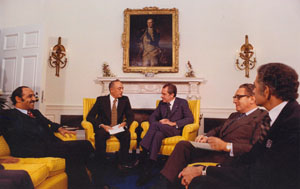 significant
losses during the first few days. The Egyptians successfully
kept forces on the Canal's east bank, but success turned into
near disaster as Israeli troops, led by General Ariel Sharon,
among others, launched counter-offensives, seized positions
on the Canal's west bank and trapped Egypt's Third Army. U.S.
diplomatic intervention saved Egyptian forces from destruction.
Syria fared worse, with Israeli forces winning back control
of the Golan Heights and moving troops within striking range
of Damascus. Yet, as IDF generals would ruefully acknowledge,
Egyptian and Syrian forces fought valiantly. The human toll
was substantial. By the end of the war, 2,200 Israelis soldiers
had been killed, which in percentage terms was equivalent
to 200,000 Americans. This was four times as many as in the
Six Day War. Another 5,600 were wounded. 8,500 Arabs were
killed--many of them Syrian--but far fewer than the 61,000
lost during the Six Day War. (Note 8)
significant
losses during the first few days. The Egyptians successfully
kept forces on the Canal's east bank, but success turned into
near disaster as Israeli troops, led by General Ariel Sharon,
among others, launched counter-offensives, seized positions
on the Canal's west bank and trapped Egypt's Third Army. U.S.
diplomatic intervention saved Egyptian forces from destruction.
Syria fared worse, with Israeli forces winning back control
of the Golan Heights and moving troops within striking range
of Damascus. Yet, as IDF generals would ruefully acknowledge,
Egyptian and Syrian forces fought valiantly. The human toll
was substantial. By the end of the war, 2,200 Israelis soldiers
had been killed, which in percentage terms was equivalent
to 200,000 Americans. This was four times as many as in the
Six Day War. Another 5,600 were wounded. 8,500 Arabs were
killed--many of them Syrian--but far fewer than the 61,000
lost during the Six Day War. (Note 8)
Soon after the fighting started, the war developed into an
international crisis, not least because Washington and Moscow
had significant interests in the region. For both superpowers,
credibility was a central consideration. And as Nixon put
it, several weeks into the war, "No one is more keenly
aware of the stakes: Oil and our strategic position."
(Note 9) Both states had already armed their
respective Arab and Israeli clients and both launched massive
airlifts to sustain the battlefield strength of their allies.
Although the Egyptians and Syrians suffered battlefield reverses,
their resolve and a determined Israeli counter-attack kept
the fighting going. Angered by the U.S. airlift, the Arab
petroleum exporting states embargoed oil deliveries to the
United States, thus producing a significant energy crisis.
While both Moscow and Washington recognized the danger of
confrontation and intermittently supported cease-fires, their
political commitments made that support equivocal with destabilizing
consequences. Superpower tensions over Israeli violations
of the 22 October cease-fire escalated to the point where
the Nixon administration staged a Defcon III nuclear alert,
yet with all of the strains, détente prevented a serious
clash.
The need to avoid U.S.-Soviet confrontation made it all the
more essential for Kissinger to press Israel to let non-military
supplies reach the beleaguered Third Army. The U.S. intervention
on behalf of Sadat and his troops foreshadowed Washington's
new diplomatic role, the development for which Sadat had waged
war. In late October, Israeli and Egyptian senior officers
began meeting to work out the details of the cease-fire which
culminated, after Kissinger became involved, in the "Sinai
I" disengagement agreement of January 1974. Consistent
with Sadat's nationalist orientation, Israeli withdrawal from
Egyptian territory was his principal objective and it was
largely attained before his assassination in 1981. Nevertheless,
other issues from the 1967 war--Israeli control of the Golan
Heights and the West Bank--remain contested and a source of
dangerous tension to this day.
The ongoing Watergate crisis and the financial scandal that
brought down Vice President Spiro Agnew intersected with the
October War. Agnew's resignation and the need to appoint a
new vice president distracted Nixon. So did the constitutional
battle with Special Prosecutor Archibald Cox, Attorney General
Elliot Richardson, and Deputy Attorney General William Ruckelshaus,
whose firings--"the Saturday Night Massacre"--coincided
with Kissinger's trip to Moscow. While Nixon's political prestige
was collapsing, Kissinger's was growing even more. With Nixon
embattled, Henry Kissinger emerged as the key U.S. decisionmaker
during the October War. (Note 10)
Documents
Note: The following documents are in
PDF format.
You will need to download and install the free
Adobe
Acrobat Reader to view.
Table
of Contents
I.
The Looming Conflict
II.
On the Brink of War
III.
Coordinated Offensives
IV.
Airlifts, Battlefield Stalemates, and Oil Threats
V.
Turn of the Tide?
VI.
"The Smell of Victory" and Search for a Cease-Fire
VII.
Collapse of the Cease-Fire
VIII.
Crisis
IX.
Crisis Resolved
I. The Looming Conflict
Document 1:
Memorandum from National Security Council [NSC] Staff, "Indications
of Arab Intentions to Initiate Hostilities," n.d. [early
May 1973]
Source: National Archives, Nixon Presidential
Materials Project (hereinafter NPMP), Henry Kissinger Office
Files (hereinafter HAKOF), box 135, Rabin/Kissinger (Dinitz)
1973 Jan-July (2 of 3)
In the early spring of 1973, Sadat told Newsweek journalist
Arnaud de Borchgrave that the "time has come for a shock"
but no one at the time believe he had a plan for war. That
in October 1972 he had already made a basic decision for war,
if not its exact timing, was a well-kept secret. (Note
11) Certainly, the spring of 1973 augured the possibility
of great instability in the Middle East: a looming energy
crisis, Saudi intimations that the kingdom might use the oil
weapon in the absence of a Middle East settlement, and Israeli
raids on PLO offices in Beirut. Moreover, Egypt and other
Arab states were making quiet military moves that portended
possible action. The NSC analysts who may have prepared this
report believed that various moves that U.S. intelligence
had picked up--movement of surface-to-air missiles and bombers,
higher alert for air forces, reports on war planning, and
the like--indicated that those states were "preparing
for war." Nevertheless, they could not be sure whether
these developments indicated intentions to attack or a ploy
to put "psychological pressures" on Tel Aviv and
Washington. A safe conclusion was that "whatever the
Egyptian and Arab leaders intend at this state, the pattern
of their action thus far does not provide the Arabs with a
rational basis for an attack at an early date." Sadat
would not take military action "within the next six weeks,"
probably not before the "next UN debate." At the
close of May, however, a few weeks after the preparation of
this report, Roger Merick, an analyst at State Department's
Intelligence and Research prepared a report forecasting a
"better than 50 percent chance of major" Egyptian-Israel
hostilities within six months. (Note 12)
The INR estimate, which has not yet been found and declassified,
generated greater interest in the State Department in steps
to facilitate Arab-Israeli negotiations.
Document 2A: Memorandum
of Conversation [Memcon] between Muhammad Hafez Ismail and
Henry A. Kissinger, 20 May 1973, 10:15 a.m.
Source: RG 59, Records of Henry Kissinger, box 25, Cat C
Arab-Israeli War
Document 2B: Memorandum
from Kissinger to the President, "Meeting with Hafiz
Ismail on May 20," 2 June 1973
Source: NPMP, HAKO, box 132, Egypt/Ismail Vol VII May 20-September
23, 1972
During the late winter and spring of 1973, Henry Kissinger
held several secret meetings on Middle East issues in New
York and France with Muhammad Hafez Ismail, Sadat's national
security adviser. When they first met in February, Hafez and
Kissinger had a wide ranging, although inconclusive, discussion
of Egyptian-Israeli relations and the relationship of an Egypt-Israel
settlement to the Palestinian problem, among other issues.
This meeting did not start off well because press leaks had
disclosed U.S. plans to provide Israel with F-4 Phantom Jets,
a development that naturally discomfited the Egyptians. Kissinger
tried to persuade Hafez that the administration's step-by-step
approach balancing security and sovereignty concerns was more
likely to win Israeli cooperation than the Egyptian approach
emphasizing a comprehensive settlement of the 1967 borders.
But Hafez was skeptical, worrying, for example, that once
a step had been taken, e.g. a preliminary agreement over the
Sinai, that Washington would lose interest. Kissinger and
Ismail had further communications but they did not meet again
before war broke out. Whatever the actual diplomatic possibilities
were, Sadat had already decided that military action was essential
to break the diplomatic stalemate and get Washington's attention.
According to one of Ismail's staffers, Ahmad Maher El-Sayed,
who was present at the meetings, "What we heard from
Kissinger was `don't expect to win on the negotiating table
what you lost on the battlefield.'" In other words, Washington
could do little to help as long as Egypt was the defeated
power. Thus, Egypt had to "do something." If Kissinger
said anything to that effect privately, the present document
does not include it. Instead, it shows Ismail treating "war"
as the alternative to accepting the "status quo,"
with Kissinger plainly seeing war as a bad choice: "military
action will make [the] situation worse." In any event,
nothing that Kissinger said would encourage Sadat to reverse
the decision for war. Interestingly, however, Ismail himself
may have opposed the final decision to launch hostilities
[see Document 8]. (Note
13)
Document 3: Henry Kissinger,
Memorandum for the President's Files, "President's Meeting
with General Secretary Leonid Brezhnev on Saturday, June 23,
1973 at 10:30 p.m. at the Western White House, San Clemente,
California
Source: HAKO, box 75, Brezhnev Visit June 18-25 1973 Memcons
During 1973, the U.S.-Soviet Union détente process
continued to unfold with Nixon and Brezhnev holding a summit
meeting at Camp David and the "Western White House"
in June. With the second phase of the Strategic Arms Limitations
Talks going slowly, the summit made no progress in that area,
although it did unveil the controversial Agreement on the
Prevention of Nuclear War. During the meetings in California,
Brezhnev kept Nixon and Kissinger up late on the night of
23 June so that he could put across his concerns about the
Middle East and China. While the Soviets knew nothing of Sadat's
decisions until October, Brezhnev presciently emphasized the
danger of the Middle East situation. Sharing his apprehension
that war might break out unless the superpowers encouraged
negotiations he said: "we must put this warlike situation
to an end." Brezhnev further argued for the importance
of agreement on "principles," such as guarantees
for Israeli withdrawal from Arab territories but Nixon, while
agreeing that the Middle East was a "matter of highest
urgency," was not interested in making any decisions
that evening. Brezhnev's principles, however, were inconsistent
with the step-by-step approach that Kissinger had been pushing.
Apparently Kissinger (and probably Nixon as well) was resentful
that Brezhnev had raised this subject with no notice, as Kissinger
privately noted: "Typical of Soviets to spring on us
at last moment without any preparation."
Document 4: Theodore Eliot,
Jr., Executive Secretary State Department, Memorandum for
the Record, "Next Steps on the Middle East," 29
June 1973, enclosing, Secretary of State Rogers to Nixon,
"Next Steps on the Middle East," 28 June 1973
Source: National Archives, Record Group 59, Department of
State Records (hereinafter RG 59), Subject-Numeric Files 1970-1973
(hereinafter cited as SN 70-73, with file citation), Pol 27-14
Arab-Isr
During the summer of 1973 Secretary of State William Rogers
supported a major diplomatic initiative on the Middle East.
After Nixon's re-election in November 1972, Henry Kissinger
expected to become secretary of state but Rogers refused to
leave his post for at least six months because he did not
want to hand Kissinger a "victory." The previous
four years had marked one of the lowest points in State Department
history because Nixon and Kissinger had marginalized Rogers
and the State Department in such key policy areas such as
China, Vietnam, and U.S.-Soviet relations. Nevertheless, Nixon
had given Rogers considerable scope in Middle East policy
and Rogers had a continuous interest in finding ways to ameliorate
the Arab-Israeli conflict (although Kissinger had thwarted
many of his initiatives). After the Brezhnev-Nixon summit,
Rogers made his last stab on Middle East policy by suggesting
secret Egyptian-Israeli peace talks. Concerned about the risk
of Middle East war, superpower confrontation, and oil embargoes
if the problems continued to fester, Rogers believed that
it was essential to get the Egyptians and Israelis to stop
talking past each other on their respective interpretations
of UN Security Council Resolution 242, passed in the wake
of the Six Day War. Rogers' effort was stillborn; as the Eliot
memo shows, Nixon "did not want the Secretary to proceed,"
ostensibly because the White House was waiting to hear from
Brezhnev. Plainly, however, Kissinger was beginning to usurp
Roger's role on the Middle East issue and, no doubt, neither
Nixon nor Kissinger wanted him to get the credit for any progress
in that area. Rogers finally resigned in August 1973. It is
interesting to speculate whether a determined effort along
the lines that he proposed could have derailed the war. (Note
14)
Document 5: Memcon between
Kissinger and Israeli Ambassador Simcha Dinitz, 10 September
1973, 6:03 p.m.
Source: NPMP, HAKO, Box 135, Rabin/Dinitz Sensitive Memcons
Kissinger and the Nixon White House were under growing pressure
to move on Middle East diplomacy but while they would make
appropriate public signals, they saw no need to move quickly.
On 5 September 1973, during a press conference, Nixon declared
that the administration had important plans for Middle East
negotiations: "we have put at the highest priority ...
making some progress toward the settlement of that dispute."
(Note 15) During a conversation a few days
later with the late Ambassador Simcha Dinitz (Note
16), with whom he established a close relationship, Kissinger
explained that "the trend here to do something is getting
overwhelming. It can be delayed but it can't be arrested."
While Kissinger believed that it was important to get negotiations
going and was looking for ideas on initial steps--perhaps
a proposal on Jerusalem or a settlement with Jordan--he had
no problem with delay: he felt "no immediate pressure."
But to reduce whatever pressure there was and to maximize
U.S. leverage, Kissinger told Dinitz that he wanted to find
ways to "split" the Arabs, to keep the Saudis out
of the dispute, and to otherwise "exhaust the Arabs."
Kissinger may have used such language to ease Israeli concerns
about negotiations, but that rhetoric could also have encouraged
inflexibility. (Note 17)
Document 6: Harold Saunders,
NSC Staff, to Kissinger, "Memorandum on Your Talk with
Zahedi," 19 September 1973, enclosing memorandum of Kissinger-Zahedi
conversation, 15 September 1973, and untitled paper handed
to Zahedi on 13 August 1974
Source: NPMP, HAKO, box 132, Egypt-Ismail Vol. VI May 20-Sept
30, 1973
Kissinger's backchannel communications with the Egyptians
on a Middle East settlement continued into the weeks before
the war. This time, the intermediary was Iranian Ambassador
Ardeshir Zahedi (the son of the U.S.-backed general who had
ousted Prime Minister Mohammed Mossadegh twenty years earlier),
who had met with Ashraf Ghorbal, Ismail's deputy in Switzerland.
There Zahedi how shown him a memorandum, prepared at the White
House, which outlined the U.S. approach to negotiating a settlement,
"a step at a time" so that "propositions"
could be presented to Israel that "cannot be easily rejected."
Perhaps suspecting that Kissinger was trying to entrap Egypt
in a negotiating process with no clear end in sight, Ghorbal
was not excited by the White House paper: "it contained
some good words but not action." What he wanted was "a
tangible and concrete suggestion."
II.
On the Brink of War
Document 7:
Deputy Assistant to the President for National Security Brent
Scowcroft to Kissinger, 5 October 1973, enclosing message
from Israeli Prime Minister Golda Meir (passed through Israeli
chargé Shalev)
Source: NPMP, HAKO, box 136, Dinitz June 4, 1974 [sic]-Oct.
31, 1973
Neither Israeli nor U.S. intelligence recognized the imminence
of war in early October 1973. AMAN, the Israeli military intelligence
organization, and the leadership generally assumed that national
military power would deter war and downplayed the possibility
of conflict until 1975 when Egypt and Syria had better air
capabilities. Moreover, Israeli military and political leaders
had a condescending view of Arab fighting abilities. Rumors
of war had begun to crop up beginning in the spring of 1973
and during September 1973 AMAN began collecting specific warnings
of Egyptian-Syrian intentions to wage war in the near future.
Moreover, in late September Jordan's King Hussein warned Prime
Minister Meir that Syrian forces were taking an "attack
position." These developments concerned the Israelis
but AMAN ruled out major war. On 4 October, however, the Israelis
picked up a number of signals suggesting the imminence of
war: the Soviets were starting to evacuate the families of
advisers in Egypt and Syria; a high-level clandestine source
warned Mossad of the possibility of a coordinated attack;
and aerial reconnaissance detected an increase in gun deployments
along the Suez Canal. The next day, 5 October, with AMAN now
seeing a "low probability" of war, Meir shared Israeli
concerns with Washington. (Note 18) With
Kissinger in New York at the annual meeting of the United
Nations General Assembly, his deputy Brent Scowcroft received
this urgent message from Meir late in the day. Egyptian and
Syrian war preparations were becoming more and more noticeable
making Meir and her colleagues wonder whether 1) those countries
anticipated an Israeli attack, or 2) intended to "initiate
an offensive military operation." She asked Kissinger
to convey to the Arabs and the Soviets that Tel Aviv had no
belligerent intentions, but that if Egypt or Syria began an
offensive, "Israel will react militarily, with firmness
and great strength."
Document 8:
U.S. Interests Section Egypt, Cable 3243 to State Department,
"Soviet View on Causes and Timing of Egyptian Decision
to Resume Hostilities," 26 October 1973
Source: NPMP, NSCF, box 1175, 1973 War (Middle East) 26 October
1973-File No. 21
During the weeks before the war, the Soviets believed that
the situation was growing more dangerous, but like the Americans
and the Israelis they did not see the "resumption of
fighting [as] at all likely." Yet, they had begun to
evacuate dependents because they had learned of the decision
for war, but not its exact timing, a few days ahead of the
event. As the war unfolded, U.S. diplomats in Cairo picked
up interesting gossip about Soviet foreknowledge and Egyptian
debate over war from a suspected Russian Intelligence Services
(RIS, or KGB) official, Leo Yerdrashnikov (whose official
cover was deputy director of the local Tass office). His account
is fascinating although some details are unconfirmable, at
least with sources known to this writer. Interestingly, in
the discussion of Sadat and his advisers, Yerdrashnikov claims
that Hafez Ismail was among those who argued against war because
a "policy of rapprochement … was working in Egypt's
favor." The Soviet also claimed that Sadat had told Saudi
Arabia's King Faisal of his decision in August and that the
King had "encouraged" Sadat. Yerdrashnikov also
sheds light on when the Soviets learned of Sadat's decision.
On 3 October, Sadat told Soviet Ambassador Vladimir Vinogradov
that war was imminent. Moscow did not, however, learn when
the war would start until the morning of 6 October. (Note
19)
Document 9:
U.S. Embassy Israel, Cable 7766 to Department of State, 6
October 9988, "GOI Concern About Possible Syrian and
Egyptian Attack Today"
Source: NPMP, National Security Council Files (hereinafter
NSCF), box 1173, 1973 War (Middle East) 6 Oct. 1973 File No.
1 [1 of 2]
Apparently, Kissinger did not receive Meir's message [Document
7] until the next morning, when he passed a copy to Soviet
Ambassador Dobrynin to corroborate Israeli concern. (Note
20) In any event, Kenneth Keating, the U.S. Ambassador
to Israel, provided more specific news in a message that arrived
sometime before 6 a.m.: the Israelis believed that Egypt and
Syria would launch a coordinated attack within six hours.
The Israeli's "Top Source," an Egyptian (who may
have been a double agent) had provided warning that war would
begin that day. Shocked and surprised by the possibility of
war, Golda Meir put it this way: "we may be in trouble."
Some of Meir's advisers urged a preemptive strike, but the
prime minister assured Keating that Israel would not launch
a pre-emptive attack; she wanted to "avoid bloodshed"
and, no doubt, the opprobrium associated with striking first.
Instead, the Israelis ordered the mobilization of 100,000
troops, a disorganized process that took several days. At
2:00 p.m., the Egyptians and Syrians, aided by a successful
deception plan, launched their attack. As Egyptian Major General
Talaat Ahmed Mosallam later put it, the surprise was so complete
"because of both the Arab plan and the failure of the
Israelis to understand or even believe what they saw with
their own eyes." (Note 21)
Document 10:
Message from Secretary Kissinger, New York, to White House
Situation Room, for delivery to President Nixon at 9:00 a.m.,
6 October 1973
Source: NPMP, NSCF, box 664, Middle East War Memos &
Misc October 1-October 17, 1973
At 6:00 a.m., Assistant Secretary of State Joseph Sisco woke
his boss with Keating's message. As this document shows, Kissinger
immediately took the reins of power and began making phone
calls and sending messages urging restraint by all concerned
parties. That morning, Kissinger got in touch with Nixon (who
was in Florida) only after he had made a series of calls,
first to Dobrynin, asking that the Soviets hold back Cairo
and Damascus. He also called Israeli chargé Shalev,
advising him to inform his government "that there must
be no preemptive strike." Later, having received Israeli
assurances about preemption, he told Dobrynin and Egyptian
Foreign Minister Zayyat that there would be no such strikes.
Interestingly, Kissinger has never acknowledged that he recommended
against preemption, although his recent collection provides
more confirming information on this point. (Note
22)
Document 11: U.S. Mission
to United Nations cable 4208 to U.S. Embassy Israel, 6 October
1973
Source: NPMP, NSCF, box 1173, 1973 War (Middle East) 6 Oct.
1973 File No. 1 [1 of 2]
Hoping that he could avert war, Kissinger wired Ambassador
Keating, informing him of his other efforts to secure Arab
and Israeli restraint and of his "appreciation"
for Meir's assurance that there would be no preemptive moves.
Document 12: U.S. Department
of State cable 199583 to U.S. Embassies Jordan and Saudi Arabia,
"Message from Secretary to King Faisal and King Hussein,"
6 October 1973
Source: NPMP, National Security Council Files (hereinafter
NSCF), box 1173, 1973 War (Middle East) 6 Oct. 1973 File No.
1 [1 of 2]
During the course of the October War, Kissinger tried to
demonstrate impartiality by communicating with the leaders
of Arab governments he considered "moderate," such
as Jordan and Saudi Arabia, among others. In this message,
prepared for Kings Faisal and Hussein, Kissinger related his
efforts to avert war and vainly asked their help in securing
"restraint" on Assad's and Sadat's part. Within
a few days, Kissinger would soon begin back channel communications
with Ismail and Sadat.
Document 13:
Memorandum from William B. Quandt to Brent Scowcroft, "Arab-Israeli
Tensions," 6 October 1973
Source: NPMP, NSCF, box 1173, 1973 War (Middle East) 6 Oct.
1973 File No. 1 [1 of 2]
Saturday morning, before the U.S. learned that war had broken
out, the Washington Special Action Group (WSAG) met in the
White House Situation room in Kissinger's absence. (Unfortunately,
all but one of the WSAG meeting minutes remain classified).
According to one account, during the meeting, Director of
Central Intelligence Colby opined that neither side was initiating
war but that the conflict was the result of an "action-reaction
cycle." (Note 23) This document, prepared
by NSC staffer William Quandt, reflects the uncertainty of
that morning. In light of Meir's warning, Quandt tried to
interpret the various signs of impending conflict: evacuation
of Soviet advisers, Egyptian forces on a high state of alert,
and the positioning of Syrian forces at the Golan Heights.
One possibility was that the evacuation of Soviet advisers
meant that Moscow "had gotten wind" that war was
imminent. Another possibility was a "major crisis in
Arab-Soviet relations." Indeed, "downplay[ing] the
likelihood of an Arab attack on Israel," U.S. intelligence
saw an Arab-Soviet crisis as a more plausible explanation.
This was consistent with the received wisdom in the intelligence
establishment that the Arabs would not initiate war as long
as the military balance favored Israel. In other words, Tel
Aviv's preponderant military power deterred war. This was
the prevailing view of Israeli intelligence and U.S. intelligence
bought into it. A few weeks later, Assistant Secretary of
State Intelligence and Research Ray Cline observed, "Our
difficulty was partly that we were brainwashed by the Israelis,
who brainwashed themselves." (Note 24)
Brainwashed or not, Quandt suggested a number of actions "if
hostilities are imminent."
III.
Coordinated Offensives
Document 14: Message from
Soviet Government to Nixon and Kissinger, 6 October 1973,
called in at 2:10 p.m.
Source: RG 59, SN 70-73, POL 27-Arab-Isr
This message conveys Brezhnev's and the Politburo's concern
about the Middle East "conflagration." Although
far from straightforward about when they first learned of
Sadat's war plans, the Soviets were no less shocked than the
Americans by the Egyptian and Syrian decisions for war. For
Brezhnev and his colleagues, war was a "gross miscalculation,"
a "major political error," because they believed
that the Arabs were sure to lose. Recognizing the danger of
the situation for superpower relations, during the first days
of the war the Soviets pressed their Egyptian and Syrian clients
for a cease-fire. At the same time, however, Brezhnev wanted
to maintain Soviet influence in the region, thus, Soviet policy
had to avoid a military and political disaster for Egypt and
Syria. The tension between détente and credibility
concerns would shape Soviet policy throughout the conflict.
(Note 25)
Document 15: Memorandum
from William Quandt and Donald Stukel, NSC Staff, "WSAG
Meeting -- Middle East, Saturday, October 6, 1973, 3:00 p.m."
Source: NPMP, National Security Council Institutional Files,
box H-94, WSAG Meeting, Middle East 10/6/73 7:30 pm., folder
1
As Israelis were observing Yom Kippur, the Egyptians and
Syrians launched their attacks. Just after 2:00 p.m. (Cairo
time) 100,000 Egyptian troops and 1,000 tanks engulfed Israeli
forces on the east bank of the Suez Canal while 35,000 Syrian
troops and 800 tanks broke through Israeli positions on the
Golan Heights. (Note 26) Providing Kissinger
with some background information for another WSAG meeting,
held early that evening, NSC staffers believed that senior
officials had to start considering a number of issues, such
as steps to minimize threats to U.S. interests, e.g., an Arab
oil embargo, possible Soviet moves, and the "consequences
of a major Arab defeat." With respect to the Soviet position,
Kissinger's advisers believed that the key question was how
Washington could "best take advantage of this crisis
to reduce Soviet influence in the Middle East." But if
Moscow's influence was to be reduced, it could not be the
result of a "major Arab defeat" because that could
endanger U.S. interests in the region, destroy the possibility
of a settlement, and weaken "moderate" Arab regimes.
The advantages of finding ways to "minimize" Arab
"loss of face" required serious consideration.
Document 16: Memorandum
to Kissinger, initialed "LSE" [Lawrence S. Eagleburger],
6 October 1973
Source: RG 59, SN 70-73, Pol 27-14 Arab-Isr
At the outset, the Israelis did not want UN Security Council
action on a cease-fire because it could prevent them from
reversing initial Arab gains. During a conversation with Foreign
Minister Abba Eban at 9:07 a.m, Kissinger indirectly assured
him that Washington would not immediately go to the Security
Council; this satisfied Eban because it would let the Israelis
decide whether to "[do] it quickly." While Kissinger
would soon consider Security Council action to stop the fighting,
the Israeli position on a cease-fire influenced his thinking.
Sometime during the day, Eban spoke with Kissinger's executive
assistant, Lawrence Eagleburger, (Kissinger must have been
temporally occupied) and registered his appreciation that
Kissinger would defer UN action so that Israel had "time
to recoup its position." In other words, the Israelis
sought a cease-fire based on the status quo ante. To
give the Israelis time to do that, Eban asked for a delay
on any Security Council action until Monday. By the time Eban
spoke with Kissinger later in the day, the latter had seen
Eagleburger's memo and Eban had nothing to worry about. Having
decided that Washington had to "lean" toward Tel
Aviv in order to restrain the Arabs and the Soviets but also
to get more leverage over the Israelis during the negotiating
phase, Kissinger tacitly assured the foreign minister that
Washington would not be "precipitate" in seeking
Security Council Action. In any event, the Soviets were interested
in a cease-fire and so was Assad--if the fighting stopped
he would have control of the Golan Heights. Sadat, however,
was not ready to halt until he had a stronger position on
the Sinai. (Note 27)
Document 17: Memcon between
Kissinger and Ambassador Huang Zhen, PRC Liaison Office, 6
October 1973, 9:10- 9:30 p.m.
Source: RG 59, Records of the Policy Planning Staff, Director's
Files (Winston Lord), 1969-1977. Box 328. China Exchanges
July 10-October 31, 1973
Back in Washington, at the close of the day Kissinger had
one of his confidential talks with Huang Zhen, Beijing's representative
in Washington. Rather frankly, Kissinger disclosed elements
of his grand strategy; he assured the Chinese that "our
strategic objective is to prevent the Soviets from getting
a dominant position in the Middle East." Believing that
the Israelis would achieve a quick victory over the Arabs
in a few days, Kissinger wanted to demonstrate to the Arab
states that "whoever gets help from the Soviet Union
cannot achieve his objective." Moreover, to the extent
that the Arabs believed that they could win some territory
before agreeing to halt the fighting, Kissinger wanted to
slap down that belief by supporting a cease-fire based on
a "return to the status quo ante." The Chinese were
sympathetic to the Arab cause so Kissinger had to be able
to assure progress on Arab grievances. Once negotiations begin,
"we will have to separate ourselves from the Israeli
point of view to some extent." That would be possible,
however, if Washington could offer security guarantees for
"new borders after the settlement."
Document 18:
Memcon between Dinitz and Kissinger, 7 October 1973, 8:20
p.m.
Source: RG 59, Records of Henry Kissinger, 1973-1977. Box
25. Cat C 1974 Arab-Israeli War
The first page of this document is mostly illegible--except
for a few scraps on U.S. supply of Sidewinder (air-to-air)
missiles and bomb racks--but it provides interesting detail
on the early moments of the war, such as Israeli cabinet debates
on the question of whether to preempt or not. Apparently advice
that Kissinger had given in the past--"whatever happens,
don't be the one that strikes first"--played no small
part in Meir's thinking. With war underway, Kissinger assumed
that Israeli forces would soon reverse Egyptian advances;
therefore, he wanted to delay action at the UN Security Council
to enable the IDF to "move as fast as possible."
The Israelis were seeking military aid---Sidewinder missiles,
planes, ordnance, ammunition, and aircraft parts--but aircraft
was the priority of the moment. Kissinger, however, was not
so sure that aircraft could be provided "while the fighting
is going on," although he thought it possible to make
Sidewinders and bomb racks available. As for the Soviets,
Kissinger did not show much concern: "in all their communications
with us, they were very mild."
Document 19: Department
of State, Operations Center, Middle East Task Force, Situation
Report # 8, "Situation in the Middle East, as of 2300
Hours (EDT, Oct. 7, 1973"
Source: NPMP, NSCF, box 1173, 1973 War (Middle East) 7 Oct.
1973 File No. 2
During the first day of the fighting, Arab forces made significant
gains--the Syrians had penetrated the Golan Heights while
the Egyptians had moved into the Sinai past the east bank
of the Suez Canal. Given the great strategic value of the
Golan Heights, so close to Israeli population centers, the
Israelis started to throw in forces there first. (Note
28) To keep officials abreast of developments, the State
Department's Middle East Task Force, lodged at the Department's
basement Operations Center, regularly issued "sitreps"
on military and political developments. This one, produced
at the end of the second day of the fighting, showed a grim
situation: "major losses on both sides," a "miserably
tough day" for the Israelis.
Document 20:
Kissinger to Egyptian Foreign Minister Al-Zayyat, 8 October
1973, enclosing "Message for Mr. Hafiz Ismail from Dr.
Kissinger," 8 October 1973
Source: NPMP, HAKO, box 132, Egypt/Ismail Vol. VII October
1-21, 1973
Within a day after the war broke out, Sadat's security adviser,
Haifez Ismail, sent Kissinger a secret message, through the
Cairo CIA station, outlining his government's war aims. The
message remains classified and Kissinger found its basic terms---restoration
of 1967 borders--unacceptable, but he saw it as extraordinarily
significant: it treated Washington as the key player in the
peace process but also showed Sadat's moderation; he did not
seek to "widen the confrontation." (Note
29) Kissinger quickly responded, asking Sadat and Ismail
to clarify points about territorial withdrawal. He also asked
about the substance of a backchannel message from Sadat to
the Shah of Iran that the Iranians showed to U.S. Ambassador
to Iran Richard Helms. Given Kissinger's expectation that
the Israelis would soon be overtaking the Egyptians, he may
have anticipated that Ismail and Sadat would be interested
in his offer to "bring the fighting to a halt" and
"personally participate in assisting the parties to reach
a just resolution" of the Arab-Israeli dispute.
Document
21A: Memcon between Dinitz and Kissinger, 9 October
1973, 8:20-8:40 a.m.
Source: RG 59, Records of Henry Kissinger, box 25, CAT C
Arab-Israeli War
Document 21B: Memcon
between Dinitz and Kissinger, 9 October 1973, 6:10-6:35 p.m.
Source: RG 59, SN 70-73, Pol Isr-US
Early in the morning of 9 October, Kissinger received a call
from Dinitz that Israeli forces were in a more "difficult"
position. A counter-offensive launched the previous day had
failed with major losses. At 8:20, the two met for a more
detailed conversation, with a chagrined Dinitz acknowledging
that the Israelis had lost over 400 tanks to the Egyptians
and 100 to the Syrians. Egyptian armor and surface-to-air
missiles were taking their toll in the air and ground battle
and the Israeli cabinet had decided that it had to "get
all equipment and planes by air that we can." Kissinger,
who had assumed that Tel Aviv could recapture territory without
major infusions of aid, was perplexed by the bad news--"Explain
to me, how could 400 tanks be lost to the Egyptians?"--and
the diplomatic implications of substantial U.S. wartime military
aid was troublesome. As indicated on the record of the 8:20
a.m. meeting, Dinitz and Kissinger met privately, without
a notetaker, to discuss Golda Meir's request for a secret
meeting with Nixon to plea for military aid, a proposal that
Kissinger quickly dismissed because it would strengthen Moscow's
influence in the Arab world. To underline the urgency of the
situation, Dinitz may have introduced an element of nuclear
blackmail into the private discussion. While Golda Meir had
rejected military advice for nuclear weapons use, she had
ordered the arming and alerting of Jericho missiles--their
principal nuclear delivery system--at least to influence Washington.
(Note 30) Kissinger has never gone on record
on this issue and no U.S. documentation on the U.S. Israeli
nuclear posture during the war has been declassified. Whatever
Dinitz said, Kissinger was responsive to the pleas for more
assistance. Later, when the WSAG considered the Israeli position,
it recommended the supply of arms as long as Washington kept
a low profile. Meeting Dinitz later in the day, Kissinger
told him that Nixon had approved the entire list of "consumable"
items sought by the Israelis (except for laser bombs) would
be shipped. Moreover, aircraft and tanks would be replaced
if the need became "acute." To ensure that the U.S.
role had low visibility, Israeli cargo plans would have the
El Al markings painted out. Moreover, discussion of arrangements
to charter U.S. commercial aircraft for shipping war material
began on the U.S. side. During that meeting, Dinitz had better
news to report: progress on the Golan Heights and the massive
destruction of Syrian tanks.
Document 22: William Quandt
to Kissinger, "Middle Eastern Issues," 9 October
1973
Source: NPMP, NSCF, box 664, Middle East War Memos &
Misc. Oct. 6-Oct 17, 1973
Pointing to risky developments--Israel's losses and request
for supplies, the probability that fighting would "drag
on" for more days, threats to U.S. citizens in Lebanon,
calls from Kuwait for use of the oil weapon, and reports of
Soviet casualties from Israeli bombing in Syria--Quandt advised
Kissinger that he would have to consider decisions on a number
of problems. Meeting Israel's arms requests "too visibly"
could endanger U.S. citizens but holding back would undermine
Tel Aviv's confidence in U.S. policy. For Quandt, the "key
problem" was a cease-fire. The earlier position favoring
a cease-fire based on the status quo ante had become
less and less tenable because of the "prospects for increasingly
serious threats to US interests if the fighting is prolonged."
Pushing for a "ceasefire in place," however, was
likely to "irritate" the Israelis, who were trying
to recover lost territory. Tel Aviv might charge a high price,
such as "strong" diplomatic and military support
after the war, but Quandt thought it might be "worth
the cost." Whatever impact this suggestion may have had
on Kissinger's thinking, he brought up the possibility of
a cease-fire in place during a phone conversation with Dinitz
later in the day. (Note 31)
IV.
Airlifts, Battlefield Stalemates, and Oil Threats
Document 23: Department
of State, Operations Center, Middle East Task Force, Situation
Report #18, "Situation in the Middle East, as of 1800
EDT, Oct. 10, 1973"
Source: NPMP, NSCF, box 1174, 1973 Middle East War - 10 October
1973 File No. 5
While Arab and Israeli ground forces were "sparring
and regrouping," Syrian and Israeli air forces were engaged
in battle and the Israeli Air Force bombed the international
airport at Damascus. Meanwhile, Greek, Israeli, and U.S. intelligence
picked up signs that the Soviets were airlifting supplies
to their Arab clients. "The Israelis speculate the main
cargo is missiles." As for the U.S. effort to supply
Israel, the U.S. press had already observed an Israeli Boeing
707 picking up missiles and bombs in Norfolk, VA. Moreover,
comments by Sheik Yamani, Saudi Arabia's Minister of Petroleum,
suggested that the U.S. military supply of Israel would have
a cost--cutbacks in oil production. The Soviets had made their
airlift decision early in the war, believing that extensive
support could enhance Moscow's prestige in the Arab world.
This decision had significant implications for the course
of the war; not only did the airlift encourage the Egyptians
and Syrians to continue fighting it came to be seen in Washington
as a "challenge" to American power. (Note
32)
Document 24: U.S. Interests
Section in Egypt, cable 3942 to State Department, "Current
Egyptian Military Position," 10 October 1973
Source: NPMP, NSCF, box 638, Arab Republic of Egypt IX (Jan-Oct
73)
A secret source within the Egyptian government provided the
U.S. Interests Section with current information on battlefield
and political developments. Some of this intelligence reached
the Associated Press, which reported conflicting information
on Egyptian war aims: either to take "all of Sinai"
or to hold ground deep enough into the peninsula to force
a cease-fire in place. While the plan that Sadat has shown
Assad aimed at forty kilometer incursions into the Sinai,
the actual Egyptian war plan posited a far more limited attack,
enough to get Washington's attention and force Tel Aviv to
negotiate. The information provided by the source suggested
a more restricted incursion than Sadat had originally anticipated
(20 kilometers instead of 60), but the intimation of limited
purposes was correct. Given that had concealed from Assad
his limited goals, a press leak of this sort was undoubtedly
highly disturbing to the Egyptian leadership. Apparently,
the AP report upset the informant so much that the Interests
Section observed that "If this continues, source cannot
continue to produce."
Document 25: Yuli Vorontsov,
Minister-Counselor, Soviet Embassy, to Scowcroft, 10 October
1973, enclosing untitled paper, delivered 11:15 a.m.
Source: NPMP, HAKO, Dobrynin/Kissinger Vol. 19 (July 13,
1973-Oct 11, 1973)
Skeptical that the Arabs would make lasting military gains
and worried about the war's impact on U.S.-Soviet détente,
Moscow was interested in a cease-fire throughout the conflict.
But Sadat wanted to keep fighting in order to get political
concessions from Israel while the latter rejected a cease-fire
that left Arab territorial gains in place. By 10 October,
Soviet interest in a cease-fire was more serious; the fighting
was stalemated and the Politburo estimated that the Arabs
would not make further military gains. That morning, Dobrynin
called Kissinger informing him that Moscow was interested
in a Security Council resolution for a cease-fire in place
as long as a third party introduced it and Moscow would not
have to vote for it. As the memo suggests, it had been difficult
for the Soviets to persuade the Egyptians to accept a resolution
(by contrast, Assad wanted a cease-fire to stop Israeli advances).
To give their clients some cover, the Soviets would have to
maintain some distance from any resolution. Kissinger stalled
on the Soviet proposal ostensibly because of Vice President
Agnew's resignation (owing to a financial scandal). Kissinger,
however, wanted to give Tel Aviv time for military advances.
In between conversations with Dobrynin, he advised Dinitz
to the effect that "Everything depended on the Israelis
pushing back to the prewar lines as quickly as possible …
We could not stall a cease-fire proposal forever." By
the time the Israelis were supporting a cease-fire resolution,
they had begun making military gains, but those gains turned
Sadat against the proposal. That, the Soviets regarded as
a "gross political and strategic blunder." While
Kissinger's dilatory tactics irritated Moscow, the Soviets
continued their airlift. As Soviet Middle East expert Victor
Israelian later suggested, "the motivations of the two
superpowers were the same," with both were trying to
"assist their clients in their deteriorating military
situation. (Note 33)
Document 26: Memcon between
Deputy Secretary of State Kenneth Rush and Petroleum Company
Executives, "The Middle East Conflict and U.S. Oil Interests,"
10 October 1973
Source: RG 59, SN 70-73, POL 27Arab-Isr
While Kissinger was trying to put off the Soviet cease-fire
proposal, Deputy Secretary of State Kenneth Rush heard out
top executives from Exxon and Gulf Oil on the possible use
of the oil weapon during the war. The executives had asked
for the meeting because they had learned that Kuwaiti Oil
and Finance Minister Abdel Rahman Atiqi, who had already called
for an emergency meeting of Arab oil ministers to discuss
the role of petroleum in the war, was warning Washington to
avoid action that could lead to precipitate moves against
"U.S. oil interests." Believing that the Arabs had
the companies "at their mercies," the oil executives
worried that if Washington started to replace Israeli aircraft
losses, radicals like Qadhafi would get the upper hand and
the companies would be nationalized. Also in prospect were
price increases of 100 percent and the curtailment of oil
production. Rush was also concerned about the impact of prolonged
fighting but he could not promise the executives what they
wanted: a U.S. statement against arms shipments to the Middle
East. As State Department official Roger Davies noted, the
Soviet airlift, then just beginning, would increase pressure
to "resupply Israel."
Document 27: Department
of State, Operations Center, Middle East Task Force, Situation
Report #22, "Situation Report in the Middle East, as
of 0600 EDT, 10/12/73"
Source: NPMP, NSCF, box 1174, 1973 Middle East War - 12 October
1973 File No. 7
On 11 October the IDF continued their offensive against Syrian
forces, the next day breaching the "main Syrian defensive
line" and recapturing the Golan Heights. The situation
on the Suez front remained "static," with an artillery
battle under way. The Soviet airlift unfolded causing apprehension
among the Israelis about the restoration of Syrian SAM capabilities.
Meanwhile, Nixon, Kissinger, and Secretary of Defense James
Schlesinger were beginning to make major decisions on the
U.S. supply operation. While Kissinger and Schlesinger had
sought to contract private U.S. aircraft to move supplies,
this proved impractical because U.S. companies wanted to stay
away from the conflict. Moreover, on 12 and 13 October, Kissinger
was getting reports that the Israelis were running low on
ammunition. Although he was not sure if Dinitz was telling
him the truth about ammunition supplies----"How the hell
would I know," he told Schlesinger--he did not want to
risk any Israeli failure in "going as a fierce force."
When it became evident that civilian charter aircraft could
not be mobilized, on 13 October Nixon ordered a major U.S.
military airlift to supply Israel. To his staff, Kissinger
justified this move as part of his diplomatic strategy: having
failed to win Egyptian support for a cease-fire resolution
at the United Nations, it was necessary to prolong the fighting
to create a "situation in which [the Arabs] would have
to ask for a cease-fire rather than we." [See Document
63]. (Note 34)
Document 28: Assistant
Secretary for Near Eastern Affairs Joseph Sisco to Kissinger,
"Proposed Presidential Message to King Faisal,"
12 October 1973, with State Department cable routing message
attached
Source: RG 59, SN 70-73, POL 15-1 US/Nixon
Given the Nixon administration's continued concern over the
position taken by "moderate" Arab regimes, policymakers
were pleased to receive what they saw as a restrained communication
from King Faisal. In the continued effort to woo Faisal, the
State Department prepared a reply for Nixon's signature. Stressing
Washington's balanced, "pro-peace" stance, the message
delicately encouraged Faisal to keep out of the conflict and
avoid taking actions that could hurt Israel or Washington:
it was important to conduct "ourselves in such a way
that it will not be impossible for the US to play a helpful
role once the fighting is over."
Document 29A: State
Department Cable 203672 to U.S. Embassy, Saudi Arabia, "Message
to the King from the Secretary, 14 October 1973
Source: NPMP, NSCF, box 1174. 1973 Middle East War 15 - 15
October 1973 File No. 9
Document 29B: U.S. Embassy
Saudi Arabia, Cable 45491 to State Department, "US Arms
to Israeli: Saudis Sorrowful: King May Send Another Message,"
16 October 1973
Source: NPMP, NSCF, box 1174. 1973 Middle East War 15 - 16
October 1973 - File No. 11
A U.S. military airlift to Israel could not occur in secret
and Kissinger's State Department initiated a coordinated diplomatic
campaign to minimize the adverse political impact on the Arab
countries. Before the State Department started briefing other
governments in the region about the airlift, Kissinger wanted
to explain his decision through a private message to Faisal.
Recognizing that the only way he could make the airlift palatable
to the Saudis was on anti-Communist grounds (the kingdom had
never established diplomatic relations with Moscow), Kissinger
played up the anti-Soviet angle, suggesting that what had
made the U.S. decision "inevitable" was insufficient
Soviet cooperation in the latest cease-fire talks and the
Soviet "massive airlift." Moreover, the administration
had to make this decision "if we are to remain in a position
to use our influence to work for a just and lasting peace."
In other words, by helping Israel Washington would be in a
position to press Tel Aviv for concessions during peace talks.
That Kissinger hardly mollified Faisal is indicated in the
marginal notation: "Faisal angry at this." Although
Faisal's response to Nixon remains classified, apparently
he wrote that the U.S. decision had "pained" him.
Yet, the Saudis were careful to conceal any antagonism; as
the cable from Ambassador James Akins suggests, the embassy
in Riyadh discerned "no visible anger … but rather
genuine expression of sorrow." (Note 35)
Document 30: Department
of State, Operations Center, Middle East Task Force, Situation
Report #32, "Situation Report in the Middle East as of
1200 EDT, Oct. 15, 1973"
Source: NPMP, NSCF, box 1174, 1973 Middle East War - 15 October
1973 File No. 10 (2 of 2)
After what amounted to a week-long, "operational pause,"
on 4 October the Egyptians began a major tank offensive on
the Sinai, the "largest armored battle since World War
II." Asad had been pressing Sadat for action to relieve
pressure on the Syrian front, but the Israelis quickly reversed
the offensive. (Note 36) The Egyptians suffered
significant losses--76 tanks according to Egyptian sources,
280 according to the Israelis--a defeat that opened the way
to IDF advances across the Suez Canal. The Israeli air force
was heavily engaged in combat operations, attacking airfields,
fuel depots, tanks, and missile batteries in Egypt and Syria.
On the oil front, oil company and embassy officials believed
that King Faisal would take "'some' retaliatory"
action if the United States announced that it was airlifting
military supplies to Israel.
Document 31: Seymour Weiss,
Director, Bureau of Politico-Military Affairs, Department
of State, to Kissinger, "Armed Shipments to Israel,"
15 October 1973
Source: RG 59, Top Secret Subject-Numeric Files, 1970-1973,
box 23, DEF G
The Pentagon organized the airlift to Israel out of the Joint
Staff's Logistics Readiness Center (LRC). Given the high stakes
involved, State Department officials believed it essential
to monitor the airlift's progress, not least so that they
could resolve any political problems that emerged. At the
outset this proved difficult; an Air Force Colonel Wieland,
who was working for the State Department at the LRC, found
himself "prematurely invited out" by the Defense
Department. While Wieland's supervisor, Seymour Weiss, would
have to turn the bureaucratic wheels to reinsert the State
Department into the LRC, he was nevertheless able to provide
an initial report on the airlift's status. Seventeen flights
a day were already scheduled with 25,000 tons of supplies
approved for shipment. Among the items that had already been
delivered were F-4s (Phantom jets), Sidewinder air-to-air
missiles, anti-tank weapons, and artillery projectiles, among
other items. Weiss mentioned a diplomatic problem: Egypt had
lodged a protest with the West German government against the
movement of military supplies from U.S. bases to Israel. Despite
that protest, the United States continued to supply the Israelis
from U.S. bases in Germany for the time being. Weiss's reference
to the "over-taxed" airbase at Lajes (the Azores)
signaled another diplomatic problem: none of the other bases
mentioned--Torrejon in Spain or Mildenhall in the United Kingdom--would
be available for refueling empty aircraft returning from Israel.
While it took severe diplomatic pressure--a "harsh note"
from Nixon (Note 37)--to secure Portuguese
cooperation, Kissinger would be highly pleased with the Portuguese
during the airlift while his anger with other Europeans steady
grew.
Document 32A: U.S. Mission
to NATO Cable 4936 to Department of State, "NATO Implications
of the Middle East Conflict: NAC Meeting of October 16, 1973,"
16 October 1973
Document 32B: U.S. Mission
to NATO Cable 4937 to Department of State, "NATO Implications
of the Middle East Conflict: NAC Meeting of October 16, 1973,"
16 October 1973
Source: NPMP, NSCF, box 1174, 1973 Middle East War, 16 Oct.
1973-File No. 11 [1 of 2
During the first week or so of the crisis, Kissinger learned
that NATO Secretary General Josesph Luns had said something
to the effect that Washington "had been taken in by the
Soviets on détente and we are now paying the price
for détente" (see Document 75).
Taking advantage of a restricted North Atlantic Council (NAC)
meeting on the war, Donald Rumsfeld, the U.S. permanent representative
(with Ambassadorial rank) to the North Atlantic Council, reviewed
U.S. policy with his Canadian and European counterparts and
expressed displeasure at such criticisms. Describing U.S.
policy early in the war, the decisions for an airlift to resupply
Israel, and the ongoing diplomatic efforts to end the fighting,
Rumsfeld saw the "present crisis [as] a test of the evolving
spirit of détente." He tartly observed that "we
do not take kindly to suggestions that the U.S. was foolishly
drawn into détente relationships with the USSR."
In light of the danger that the Soviets might tip the military
balance, Rumsfeld asked alliance partners to cooperate in
finding ways to "make clear to the Soviets that détente
is a two-way street." Later in the discussion, he suggested
a number of measures that the Allies could take to "damage"
Soviet interests "if the choose to damage ours,"
including slowdown Western participation in the Conference
on European Security and Cooperation or "economic measures,"
presumably denial of credits or exports. As Rumsfeld noted,
the Council emphasized "Alliance solidarity" but
his summary overlooked some tough questions raised during
the discussion. For example, the Belgian representative, André
De Staercke, implicitly criticized Washington for not consulting
with NATO before the meeting: "consultation was an essential
part of solidarity." While Rumsfeld contended that the
present meeting was a form of consultation, de Staercke was
more interested that Washington consult with its allies on
basic decisions during the crisis.
V.
Turn of the Tide?
Document 33: Department
of State, Operations Center, Middle East Task Force, Situation
Report #36, "Situation Report in the Middle East as of
1800 Hours EDT Oct. 16, 1973"
Source: NPMP, NSCF, box 1174, 1973 War (Middle East) 16 Oct.
1973 File No. 11 [2of 2]
This sitrep pointed out the first signs of what would turn
out to be a major reversal of fortunes for Egypt: a small
Israeli armored force led by General Ariel Sharon had arrived
on the west bank of the Suez Canal to begin striking Egyptian
artillery and air defense units. Another item pointed to the
possibility of a petroleum crisis. Angered by the U.S. airlift
and then by the U.S. announcement of large-scale financial
aid to Israel, the Arab oil producers were making plans to
wield the oil weapon. This document shows the Saudis pressing
the European Community (EC) to "use their influence to
change America's policy in the Middle East." Oil would
be used as a weapon against the U.S. airlift but the production
"decrease … will hurt the EC countries first."
(Note 38)
Document 34A: William
B. Quandt to Kissinger, "Memoranda of Conversations with
Arab Foreign Ministers," 17 October 1973, with memcon
attached
Source: SN 70-73, POL 27Arab-Isr
Document 34B: Memcon
between Nixon and Arab Foreign Ministers, Wednesday, October
17, 1973, 11:10 a.m., in the President's Oval Office
Source: NPMP, NSCF, box 664, Middle East War Memos &
Misc. Oct. 6-Oct 17, 1973
Earlier in the conflict diplomats of key Arab states with
close political and/or economic ties with the United States
had sought a meeting with Kissinger and Nixon to register
their concerns about the U.S. position on a cease-fire based
on the status quo ante and the possibility of U.S.
resupply for Israel. By the time the meeting occurred, the
cease-fire issue had shifted and the U.S. airlift was in progress.
Kissinger wanted to persuade the diplomats that the U.S. position
was balanced, neither pro-Israeli nor pro-Arab, and that any
action on the part of the Arab oil producers to use the oil
weapon would "only hamper our efforts to play an effective
peacemaking role." During the discussions, Foreign Ministers
Saqqaf (Saudi Arabia), Benhima (Morocco), Bouteflika (Algeria),
and Al-Sabah (Kuwait) argued that the fighting could not end
until territory occupied in 1967 had been returned and the
Palestinian problem solved. Nixon and Kissinger, however,
refused to "make commitments we can't deliver on"
and emphasized that the broader issues of a settlement had
to be separated from a cease-fire, because if the fighting
was prolonged it could lead to a "great power confrontation."
The U.S. hoped to "improve the situation" but the
fighting had to stop first. In the meantime, the airlift would
continue to "keep the balance" in the region. Kissinger's
line of reasoning did not wholly convince his audience; as
Benhima observed, "It is difficult for [the ministers]
to convey assurances on the US position to their chiefs of
state at a time when the US is aiding Israel."
Document 35: Thomas R.
Pickering, Executive Secretary State Department, to George
Springsteen, Acting Assistant Secretary for European Affairs,
17 October 1973, enclosing memorandum by Lawrence Eagleburger,
17 October 1973
Source: RG 59, SN 70-73, POL Fr-US
As suggested earlier, U.S.-European tensions increased during
the October War. Henry Kissinger's "Year of Europe"
initiative had already produced trans-Atlantic disagreements
over the newly-enlarged EC's decisionmaking processes, and
Western Europe's close dependence on Middle Eastern oil supplies
provided the basis for disagreements during the crisis. One
of Kissinger's chief European critics, French Foreign Minister
Michel Jobert, had been suspicious of the "Year of Europe"
and dubious of Kissinger's détente strategy, which
he believed was producing a superpower condominium at Europe's
expense. On 17 October, during a speech at the National Assembly,
Jobert assailed Israel for checking the peace process and
the superpowers for fanning the flames of war with military
supplies: "We see Mr. Brezhnev, the apostle of détente,
and Dr. Kissinger, now a Nobel Peace Prize winner, shaking
hands while sending thousands of tons of arms by air."
(Note 39) The statement infuriated Kissinger
who ordered a demarché to the French ambassador. Not
only did the State Department find the references to Kissinger
"offensive and unnecessary," it rejected any equivalence
between the U.S. and Soviet positions, and found Jobert's
statement "inconsistent with good relations between the
two countries." Things would get worse.
Document
36A: Minutes, "Washington Special Action Group
Meeting," 17 October 1973, 3:05 p.m. - 4:04 p.m.
Source: NPMP, NSC Institutional Files, box H-117, WSAG Minutes
(originals) 10-2-73 to 7-23-74 (2 of 3)
Document 36B: Memcon,
"WSAG Principles: Middle East War," 17 October 1973,
4:00 p.m.
Source: NPMP, NSC Institutional Files, box H--92, WSAG Meeting
Middle East 10/17/73, folder 6
Except for this transcript, all the minutes for WSAG meetings
during the October War remain classified. At this meeting,
the participants discussed key issues: planning for an energy
crisis, the Arab-Israeli military situation and problems related
to the airlift. During the review of plans for energy conservation
in the event of an oil crisis, Kissinger showed some optimism
that, during the present war, his diplomatic strategy would
avoid Arab oil embargo, as he patronizingly observed: "Did
you see the Saudi Foreign Minister come out like a good little
boy and say they had very fruitful talks with us?" An
hour into the meeting, Nixon called in the WSAG principles
for a "pep talk." Mentioning what he saw at stake--"oil
and our strategic position"--Nixon focused on the airlift
and sealift of supplies to Israel, which he believed were
essential for preserving U.S. "credibility everywhere"
as well as for bringing Tel Aviv to a settlement. In a self-congratulatory
statement, Kissinger declared this was the "best-run
crisis" of the Nixon administration, noting that despite
the "massive airlift" TASS had issued only mild
complaints while Arab foreign ministers were making "compliments
in the Rose Garden." The congratulatory mood was premature
because the Arab oil producers had not announced the oil boycott
and production cuts that were a direct response to the airlift.
Document 37: U.S. Interests
Section in Egypt Cable 3167 to State Department, "Egyptian
Military Situation," 18 October 1973
Source: NPMP, NSCF, box 1175, 1973 Middle East War 18 Oct.
1973 File No. 13
U.S. diplomats in Egypt reported on a battle "of major
proportions" on the banks of the Suez Canal, a confrontation
that may be showing that the "offensive has begun to
move into Israeli hands if only temporarily." Signs that
"things did not go well for the Egyptians" were
the lack of military announcements and delays on the request
of a NBC News correspondent who wanted to go to the Suez front.
Those who prepared this report did not know that the IDF was
launching a plan to encircle Egypt's Third Army, a development
that would quickly spark a major crisis. (Note
40) An NSC staffer who read this cable perceptively wrote
"turn of tide?" on the document.
Document 38: U.S. Embassy
Kuwait cable 3801 Cable to State Department, "Atiqi Comment
on OAPEC Meeting," 18 October 1973
Source: NPMP, NSCF, box 1175, 1973 Middle East War 18 Oct.
1973 File No. 13
Arab oil producers had met in Kuwait to discuss wartime oil
supply policy where they decided, as this cable reported,
to begin a "complete embargo on oil to the United States."
The oil producers had decided, contrary to Kissinger, that
action on energy policy would be conducive to negotiations,
not an obstacle to them. They sought to warn the "United
States and other consumers" that the producers were "as
serious as front line fighters that Israel must give up occupied
lands." Nevertheless, apparently the Saudis insisted
that the OAPEC announcement not specifically mention the United
States but countries that were "unfriendly" to the
Arab cause.
Document 39: U.S. Embassy
United Kingdom Cable 12113 to State Department, "European
Attitudes in Middle East Conflict," 18 October 1973
Source: NPMP, NSCF, box 1175, 1973 Middle East War 18 Oct.
1973 File No. 13
For the Nixon administration, one of the most disturbing
elements in the October War was the attitude of West European
governments. As former U.S. Ambassador to West Germany Martin
Hillenbrand explained, Washington "complained vociferously
about what it regarded as European lack of support."
While key allies such as the United Kingdom discouraged the
use of their bases for U.S. aircraft supplying Israel, the
Nixon administration conducted virtually no "prior consultation"
with NATO Europe about its decisions during the war. (Note
41) This cable, signed by the media magnate Walter Annenberg,
the U.S. Ambassador to the United Kingdom, sheds some light
on the divergences. While Annenberg was clearly displeased
that the Europeans were "staying on the sidelines"
and that European attitudes had the "effect of isolating"
the United States from NATO, Conservative Member of Parliament
and confidant of Prime Minister Edward Heath James Prior believed
that cooperation was difficult because interests were divergent.
He explained that the "Middle East war posed very difficult
and serious problems for Britain" because of the importance
of Arab oil and the UK's "economic and commercial interests
in Arab states." Taking this stand plainly posed some
risks for the Heath government because a "large majority
of British public were sympathetic to Israel."
VI.
"The Smell of Victory" and Search for a Cease-Fire
Document 40: Department
of State, Operations Center, Middle East Task Force, Situation
Report # 43, "Situation Report in the Middle East as
of 0600 Hours EDT, Oct. 19, 1973"
Source: NPMP, NSCF, box 1173, 1973 Middle East War, 19 Oct.
1973-File No. 14
While the tank battle on the Sinai raged inconclusively,
Israeli forces enlarged "their bridgehead" on the
Canal's west bank with the presence of over 200 tanks. This,
the Israelis believed, gave them the option of heading toward
Cairo, thus increasing their ability to destroy the Egyptian
army. "The Israelis feel they now have turned the corner
in the war and that the initiative on both fronts is now in
Israel's hands." That the "smell of victory"
might make Tel Aviv unwilling to accept a cease-fire pointed
to a dangerous problem: the impact on U.S.-Soviet relations
if the Israelis devastated the army of one of Moscow's major
clients.
Document 41: Brezhnev
to Nixon, 19 October 1973, handed to Kissinger 11:45 a.m.
Source: NPMP, HAKO, box 69, Dobrynin/Kissinger Vol. 20 (October
12-November 27, 1973)
With the reversals on the Sinai, Sadat wanted a cease-fire
and the Soviets treated this as an urgent matter. On the evening
of 18 October, Dobrynin read to Kissinger the text of a proposed
cease-fire resolution for the UN Security Council; the next
morning, Brezhnev wrote Nixon about the crisis. (Note
42) The Soviets saw a "more and more dangerous situation"
and a responsibility by "our two powers" to "keep
the events from going beyond the limits." Anxious to
avoid a humiliating defeat for Moscow's Arab clients, worried
about damage to relations with Washington, and determined
to play a role in any post-war settlement, Brezhnev urged
Nixon to send Kissinger to Moscow for talks on expediting
the "prompt and effective political decisions" needed
to stop the fighting. (Note 43)
Document 42: Memcon between
Kissinger, Schlesinger, Colby, and Moorer, 19 October 1873,
7:17 - 7:28 p.m.
Source: NPMP, NSCF, box 1027, Memoranda of Conversations
- Apr-Nov 1973, HAK and President (2 of 5)
Hours before flying to Moscow, Kissinger gave a briefing
on Brezhnev's request and his planned trip to top defense
and intelligence officials. As Kissinger explained, going
to Moscow would delay a cease-fire resolution for a "few
days," save face for the Soviets, and avoid a worse situation:
Foreign Minister Andrei Gromyko "coming here with tough
instructions." Kissinger emphasized what he saw as the
centrality of the U.S. role: "Everyone knows in the Middle
east that if they want peace they have to come through us."
Yet while he saw the Soviets failing politically in the region,
""we can't humiliate [them] too much." A-4s
refer to Skyhawk attack aircraft.
Document 43: Nixon to
Brezhnev, 20 October 1973
Source: NPMP, HAKO, box 69, Dobrynin/Kissinger Vol. 20 (October
12-November 27, 1973)
No less than Brezhnev, Nixon saw much at risk if the fighting
continued; he quickly instructed Kissinger to travel to Moscow
to negotiate a cease-fire resolution. Given his assumption
that a trip to Moscow was a way to buy time for further Israeli
military advances, he was dismayed by Nixon's decision to
grant him "full authority" to negotiate: "the
commitments that [Kissinger] may make in the course of your
discussions have my complete support." For Kissinger,
too much freedom of action was not helpful; if he needed to
delay, for example, to help the Israelis improve their position,
he would not be able to use consultations with the President
as an excuse. (Note 44)
Document 44:
Excerpts from Backchannel U.S.-Egyptian messages, 20-26 October
1973
Source: NPMP, HAKO, box 130, Saunders-Memorandum-Sensitive
Ismail also weighed in on behalf of a cease-fire in this
message to Kissinger late in the evening of 20 October. Aware
of Kissinger's plans to meet with Brezhnev in Moscow, he hoped
that the discussions would reach agreement on a resolution
to end the fighting at "present lines." In keeping
with a speech that Sadat had given on 16 October, Ismail called
for agreement on a peace conference that would reach a "fundamental
settlement."
Document 45A: State Department
Cable 208776 to all Diplomatic and Consular Posts, "Middle
East Situation," 21 October 1973, and
Source: NPMP, NSCF, box 1175, 1973 Middle East War, 20 October
1973-File No. 15
Document 45B: Embassy
in Saudi Arabia Cable 4663 to State Department, "Saudi
Ban on Oil Shipments to U.S.," 23 October 1973
Source: NPMP, NSCF, box 1175, 1973 Middle East War, 23 October
1973-File No. 18
While Kissinger was beginning talks with Brezhnev, on 20
October, the IDF continued to advance across the Suez Canal
with the fighting heaviest on the southern front. The Syrian
front "was relatively quiet" and the Syrians were
pressing King Hussein to supply more Jordanian forces. While
Kissinger had seen the Saudi Foreign Minister as a "good
little boy," the State Department had learned that Saudi
Arabia had joined the Arab oil boycott and made the decision
to cut production significantly. According to a cable from
the U.S. Embassy in Jidda a few days later, the U.S. announcement
of a $2.2 billion aid package for Israel had infuriated King
Faisal, who took "umbrage" at the discrepancy between
the "reassuring tone" of U.S. government communications
and the announcement of the "incredible" volume
of U.S. aid for Israel. Apparently, the King also called for
a "jihad." More practically, the Saudis realized
that if they did not join the other Arab oil producers, they
would be in a politically vulnerable position. Nevertheless,
the embassy reported that the Saudis "tend to confirm
our assessment that [they wish to] minimize damage that present
crisis could cause to US-Saudi relations." Decisions
by the Arab oil producers to cut production would have a significant
impact on oil prices in the weeks ahead. (Note
45)
Document 46:
Memcon between Brezhnev and Kissinger, 20 October 1973, 9:15
- 11:30 p.m.
Source: RG 59, SN 70-73, POL 7 US/Kissinger
Kissinger's and Brezhnev's first discussion showed no disagreements
over the basic issue, the imperative of bringing about an
end to the fighting. Nor did the Soviets dissent from Kissinger's
basic proposition that there were "two problems"--ending
the fighting and a political settlement--that had to be dealt
with separately. Kissinger, however, was determined that Nixon's
unwelcome grant of negotiating authority not force him into
quick decisions that could undercut his goal of buying time
for Israeli military advances. Therefore, he observed to Brezhnev:
"If we come to some understandings, I will still want
to check them with the President." He readily agreed
with Brezhnev's statement about the importance of ending all
"slanderous allegations" that Moscow and Washington
sought to "dictate their will to others" in the
Middle East. Kissinger also expressed general agreement with
the Soviet suggestion for a cease-fire resolution although
he observed that the Israelis would reject any references
to Resolution 242. (Note 47)
Document 47:
Situation Room Message from Peter Rodman to Kissinger, TOHAK
20, 20 October 1973, transmitting memorandum from Scowcroft
to Kissinger
Source: NPMP, HAKO, box 39, HAK Trip - Moscow, Tel Aviv,
London - October 20-23, 1973 TOHAK 1-60
After meeting with Brezhnev, Kissinger was shocked to receive
a message from Scowcroft based on Nixon's dictation. Believing
a "permanent Middle East settlement" to be a critically
important goal, Nixon wanted a U.S.-Soviet agreement reached
on "general terms" which would make it easier for
both superpowers "to get out clients in line." Probably
suspecting that Kissinger was too partial to Israeli interests,
Nixon wanted his adviser to take a tough approach to both
sides. As neither the Israelis nor the Arabs would approach
"this subject … in a rational manner," Nixon
believed that Moscow and Washington had to impose a settlement:
to "bring the necessary pressures on our respective friends."
Facing continued attack in the Watergate scandal and no doubt
seeing great political advantage in a diplomatic success,
Nixon wanted Brezhnev to know that if they could reach a settlement
"it would be without question one of the brightest stars
in which we hope will be a galaxy of peace stemming from the
Nixon-Brezhnev relationship." (Note 48)
Document 48:
Message from Kissinger to Scowcroft, HAKTO 06 [20 October
1973]
Source: NPMP, HAKO, box 39, HAK Trip - Moscow, Tel Aviv,
London - October 20-23, 1973 HAKTO, SECTO, TOSEC, Misc.
Kissinger ignored Nixon's instructions. Already unhappy about
Nixon's letter to Brezhnev on his negotiating authority and
recognizing that Nixon was in no position to impose his will,
Kissinger conveyed to Scowcroft his "shock." He
argued that if he carried out the instructions it would "totally
wreck what little bargaining leverage I still have."
Nixon's vision of the superpowers imposing their will on wayward
clients was wholly inconsistent with Kissinger's determination
to extricate the Soviet Union from the Middle East peace process.
(Note 49)
Document 49:
Memcon between Brezhnev and Kissinger, 21 October 1973, 12:00
noon - 4:00 p.m.
Source: RG 59, SN 70-73, POL 7 US/Kissinger
The next Brezhnev-Kissinger meeting was scheduled for 11:00
a.m. on 22 October, but Brezhnev postponed it so the Politburo
could discuss recent communications between the Egyptians
and the Soviet ambassador in Cairo. Believing that his forces
were in desperate condition, Sadat was "begging"
for a cease-fire. By contrast, Assad no longer sought a cease-fire
because he wanted to try to recapture the Golan Heights. Assad's
concerns did not, however, influence the Soviet leadership
which agreed that it was essential to reach a rapid agreement
on a cease-fire in place, although they were careful not to
divulge any secrets about the Egyptian position in the talks
with Kissinger. The U.S.-Soviet meeting that followed drafted
a cease-fire resolution with great dispatch. Despite Nixon's
preferences for superpower co-operation to impose a settlement,
Kissinger carefully steered the Soviets away from any language
that could give them a central role in negotiating a post-war
diplomatic settlement. Using language requested by Meir and
the Egyptians, Kissinger argued that a cease-fire resolution
had to include language about negotiations "between the
parties under appropriate auspices." For the Soviets,
as Brezhnev explained later in the discussion, "auspices"
meant that Moscow and Washington would be "active participants
in the negotiations." Observing that "the Israelis
will violently object to Soviet participation," Kissinger
argued for a more qualified understanding. He stated that
auspices would mean that the superpowers would not participate
"in every detail, but in the opening phase and at critical
points throughout." Determined to buy time for the Israelis,
Kissinger reminded the Soviets several times that he had to
check with Washington, prepare a memorandum, and consult with
the President so that he understood and approved the agreement.
Moreover, while Kissinger had agreed with Brezhnev that the
resolution should be passed by midnight that evening, he sent
UN ambassador John Scali a cable advising him to "proceed
at a deliberate pace in the Security Council." "We
do not have the same interest [as the Soviets] in such speed."
(Note 50)
Document 50: Memcon between
Kissinger and Western Ambassadors, 21 October 1973, 6:30 -
6:45 p.m.
Source: RG 59, SN 70-73, POL 7 US/Kissinger
Once the cease-fire resolution had been negotiated, it was
essential to inform allies and others in order to secure UN
agreement. As indicated in Document 44,
Kissinger informed Ismail about the developments, couching
the results in language--"fundamental settlement"--that
would appeal to the Egyptians. Haig also called Dinitz telling
him that the resolution was "etched in stone and could
not be changed." (Note 51) Kissinger
also met with key ambassadors of governments that were members
of the Security Council--France, the United Kingdom, and Australia
(Lawrence McIntyre, the Council's President, was an Australian).
The meeting was brief, just enough time for a background briefing
and discussion of diplomatic strategy. Kissinger emphasized
that "anyone who is interested in a quick end to the
fighting would presumably desist from trying to make amendments."
Document 51:
U.S. Embassy Soviet Union Cable 13148 to Department of State,
21 October 1973
Source: NPMP, HAKO, box 39, HAK Trip - Moscow, Tel Aviv,
London - October 20-23, 1973 HAKTO, SECTO, TOSEC, Misc.
Before he left Moscow, Kissinger oversaw the preparation
of a number of urgent backchannel messages to foreign officials.
Owing to a breakdown of the communication system, Kissinger
had to use Moscow embassy channels, but under the special
"Cherokee" control used to limit the dissemination
of communications from the Secretary of State. This delayed
by several hours the messages to the Israeli government about
the cease-fire. One of them, a top secret cable to Ambassador
Dinitz, elucidates the crisis over Israeli encirclement of
Egypt's Third Army that unfolded during 23-24 October. In
light of the communications delay, but concerned that the
Israelis accept the cease-fire plan, Kissinger wanted Dinitz
to know that "we would understand if Israelis felt they
required some additional time for military dispositions."
Moreover, even though there would be a formal twelve-hour
interval between a Security Council decision and the actual
beginning of the cease-fire, Kissinger could "accept
Israel's taking [a] slightly longer" time. How the Israelis
interpreted "slightly longer" was out of Kissinger's
hands but this was not the only time that he would give Tel
Aviv leeway in interpreting the cease-fire. Later, when the
dangers of this advice became clear, and the Israelis had
launched a major offensive against Egypt's Third Army, Kissinger
wrote that "[he] had a sinking feeling that [he] might
have emboldened them." Whether Kissinger or Scowcroft
shared this message with Nixon remains to be seen. (Note
52)
Document 52: Department
of State Operations Center, Middle East Task Force Situation
Report # 52, "Situation Report in the Middle East as
of 1830 EDT, 10/21/73"
Source: NPMP, NSCF, box 1175, 1973 Middle East War, 21 Oct.
1973-File No. 16
While Kissinger and the Soviets were working out the details
of the cease-fire resolution, analysts at the State Department
pondered discrepant reports about the fighting on 21 October,
with the Israelis claiming major gains on the Suez Canal's
west bank and the Egyptians reporting a beleaguered Israeli
force. If the Israeli reporting was accurate and the IDF would
be in a position to cut off the Egyptian army from Cairo and
the Suez, the Defense Intelligence Agency believed that Egyptian
units on the east bank would "have only three to five
days supplies remaining." Meanwhile, with the Saudis
joining other Arab oil producers in the boycott, the loss
of oil supplies to the United States could reach two million
barrels per day.
Document 53:
Memcon between Gromyko and Kissinger, 22 October 1973, 8:45
- 9:45 p.m.
Source: RG 59, SN 70-73, POL US-USSR
The next morning, as news of the Security Council action
on what would be Resolution 338 was coming in (Note
53), Gromyko and Kissinger met for a relatively jovial
breakfast discussion once they had taken two understandings:
language on "auspices" and on the need for "maximum"
effort to ensure the exchange of prisoners-of-war within 72
hours of the cease-fire. Kissinger's next destination--Tel
Aviv--posed a delicate problem for the Soviets; as Gromyko
observed, "Psychologically … it would be preferable
if you not tell your destination from Moscow [laughing]."
For his part, Kissinger saw no problem in getting the Israelis
to accept the resolution; his visit to Israel was conditioned
on Meir's support for the resolution.
Document 54:
Memcon between Meir and Kissinger, 22 October 1973, 1:35 -
2:15 p.m.
Source: RG 59, SN 70-73, POL 7 US/Kissinger
Although Ambassador Keating had no notice about Kissinger's
plans, the secretary of state arrived in Tel Aviv for consultations
with Meir and her advisers. The jovial mood in Moscow was
forgotten; as Israeli diplomat Ephraim Evron later remarked,
"We were suffering. Henry noticed this right away."
"It did not take him long to sense that the country did
not want to go through this experience again." (Note
54) Nevertheless, there was a feeling of resentment about
the U.S.-Soviet "dictate" and Kissinger found himself
justifying Resolution 338's references to 242, which plainly
displeased Meir. He argued that, given previous U.S. efforts
on behalf of 242 in negotiations with the Soviets, it had
to be mentioned but that it did no harm to the Israeli position
because the language about "just and lasting peace"
and "secure and recognized borders" "mean nothing"
until they are negotiated. Essentially the talks were hand-holding
sessions; Kissinger tried to assuage Meir's concerns about
U.S. strategy, prisoners-of-war, the Egyptians, the continued
U.S. airlift, and Syrian Jews. In his recent book, Crisis,
Kissinger claims that he used the meetings with Meir to "establish
the cease-fire" but the conversations show a far more
ambiguous situation. Again, Kissinger gave the Israelis leeway
in interpreting the cease-fire so they could gear-up military
operations before it went into effect. He advised Meir that
if Israeli forces moved "during the night while I'm flying"
there would be "no violent protests from Washington."
Once the Israelis violated the cease-fire, however, Kissinger
would regret emboldening them, while Brezhnev became deeply
suspicious that there had been a secret deal in Tel Aviv.
(Note 55) On the airlift, Kissinger assured
Meir that "I have given orders that it is to continue"
and promised more Phantom jets and a military aid request
totaling $2.2 billion. He also filled her in on some of the
side conversations with the Soviets, who had been "very
nasty about the Arabs." On the fundamental issues, Kissinger
used brutal language that he might have thought would satisfy
his hosts: U.S. strategy was to "keep the Arabs down
and the Russians down." Those goals had been achieved:
"you have won, and I believe we have won." Whatever
the Arabs thought of Israel and the United States, Kissinger
claimed, "objective reality" forced them "to
talk to us." Only Washington could help them reach a
settlement.
Document 55: Memcon of
Luncheon for Kissinger's Party, 22 October, 2:30 - 4:30 p.m.
Source: RG 59, SN 70-73, POL 7 US/Kissinger
While at lunch, Kissinger and the Israelis discussed substantive
issues including timing of the cease-fire announcement, arrangements
for POWs, the mechanism for implementing the cease-fire, Egyptian
and Syrian fighting abilities, and prospects for a settlement.
On the cease-fire mechanism, Sisco suggested that the Israelis
"take the initiative to contact the Egyptian commanders
directly," a suggestion that foreshadowed the Kilometer
101 talks that began on 28 October. The discussion of this
important issue was inconclusive, however. On the fighting
skills of their adversaries, General Dayan reported that they
"fought better than in 1967"; in particular, the
Syrians were "determined, fanatic. It was a sort of jihad."
On the possibilities of negotiations, Kissinger was pessimistic:
"the beginning of the process will be an historic event,
even if it totally stalemates -- which I expect, frankly."
Document 56: Memcon, "Military
Briefing," 22 October 1973, 4:15 - 4:47 p.m.
Source: RG 59, SN 70-73, POL 7 US/Kissinger
Taking place only hours before the cease-fire was to go into
effect, Kissinger's last meeting in Tel Aviv consisted of
briefings by the Army and Air Force Chief's of Staff and the
director of military intelligence, with more assessments of
Arab fighting skills. Army Chief of Staff Lieutenant General
David Elaza discussed the state of play in Syria and on the
Sinai and, in a statement that anticipated the next phase
of the crisis, wistfully noted that "we didn't manage
to finish the [Egyptian] Third Army. We think it is possible
to do it in two, maybe three days." The Israelis had
been keeping the exact location of their forces a secret for
days so Kissinger kept listening, asking questions only about
details. He may have later regretted that he had not made
any cautionary remarks about the dangers of trying to "finish"
the Third Army (Note 56); instead,
he heard out assessments of Israeli strengths and weaknesses
in dealing with Soviet-supplied arms, and Egyptian and Syrian
losses.
Document 57: Department
of State Operations Center, Middle East Task Force Situation
Report #55, "Situation Report in the Middle East as of
1800 EDT, 10/22/73"
Source: NPMP, NSCF, box 1175, 1973 Middle East War, 23 Oct.
1973-File No. 14
This report shows that the Egypt-Israel cease-fire "went
into effect" on 22 October at 13:12 Eastern Daylight
Time (7:12 p.m. Cairo time), even though it was supposed to
take hold 20 minutes earlier. While reports from the field
were contradictory, the information from the Israelis suggested
that the cease-fire left Egypt in a dangerously exposed position,
with Israeli forces on the west bank of the Suez Canal straddling
strategically important roads from Cairo to Ismailia and Cairo
to Suez. The Third Army on the Suez Canal's east bank was
in danger of being entirely cut off. On the Syrian front,
the cease-fire was not yet in effect, however, because Damascus
had not yet agreed to the resolution. Moreover, the Palestinean
Liberation Organization had expressed its determination to
continue fighting against Israel. In any event, within hours
the Israelis claimed that the trapped Egyptian Third Army
was violating the agreement. With the Egyptians arguing that
no political talks with Israel would be possible until the
Israelis had withdrawn forces from the Suez Canal's west bank,
the prospects for the cease-fire were dire. Indeed, with the
IDF surrounding the Third Army, the Israelis faced no obstacle
between their forces and Cairo; they could easily have moved
to the capital and unseated Sadat. (Note 57)
Document 58: U.S. Embassy
Israel cable 8513 to State Department, "Conversation
with Prime Minister Meir," 23 October 1973
Source: NPMP, NSCF, box 1175, 1973 Middle East War, 23 Oct.
1973-File No. 18
The day after Kissinger left Tel Aviv, Ambassador Keating
met with Meir to discuss the latest developments, including
the exchange of POWs, the political opposition's rejection
of a cease-fire, British queries about U.S.-Israeli differences
over the UN resolution (prompting a comment about "perfidious
Albion" from Meir), and the possibility of military-to-military
contacts to enforce a cease-fire. A discussion of alleged
Egyptian violations of the cease-fire, reported by Israeli
Defense Forces, led Keating to raise a "delicate"
question about the likelihood that "some might view with
some skepticism info from GOI sources and … would wonder
whether or not the Israelis might not be taking initiatives
in violation of the cease-fire in order to achieve certain
military objectives." Meir acknowledged that her government
was taking the cease-fire less than seriously: it had ordered
"its troops to continue fighting until and unless the
Egyptians stop." Keating reported his concern that the
IDF would "shoot back" at the Egyptians and "launch
an attack designed to wipe out the Egyptian Third Army."
"If things reach this point [I'm] not sure what kind
of a ceasefire will be left to build on."
VII.
Collapse of the Cease-Fire
Document 59: Department
of State Operations Center, Middle East Task Force Situation
Report # 57, "Situation Report in the Middle East as
of 1200 EDT, 10/23/73"
Source: NPMP, NSCF, box 1175, 1973 Middle East War, 23 Oct.
1973-File No. 18
Whether the Egyptians or the Israelis made the first move
remains unclear but IDF violations of the cease-fire on the
night of 22 October were truly massive as it "pushed
enormous quantities of equipment across the Canal" in
order to encircle Egypt's Third Army. The Israeli claim that
they had not initiated any military actions would anger Kissinger
who understood, that it was the IDF, not the Egyptians, who
were on the offensive. Meanwhile heavy fighting continued
on the Syrian front and Syrian-Israeli forces engaged in an
air battle with the Israelis losing 10 or 11 aircraft. (Note
58)
Document 60: Message from
Brezhnev to Kissinger as read by Minister Vorontsov to the
Secretary on the telephone on October 23, 1973 at 10:40 a.m.
Source: NPMP, HAKO, box 69, Dobrynin/Kissinger Vol. 20 (October
12-November 27, 1973)
At 4:00 a.m. on 23 October Kissinger received a call that
the fighting had broken out again. In a first-time Brezhnev-to-Kissinger
message, the Soviets protested the "flagrant deceit on
the part of the Israelis" to violate the cease-fire.
From the accounts of Kremlin insiders, an angry Brezhnev had
begun to suspect that Kissinger had "fooled us and made
a deal when he was in Tel Aviv." Certainly if Brezhnev
had learned of Kissinger's statement about moving military
forces "during the night while I'm flying" he would
have been infuriated. Nevertheless, as this document shows,
Brezhnev was confident that U.S. leaders would "use all
the possibilities they have and its authority to bring the
Israelis to order." To help enforce the cease-fire he
took up a suggestion from Sadat to make use of UN observers
to separate Egyptian and Israeli forces. He also proposed
a UN Security Council meeting to draft a resolution reconfirming
338, and demanding withdrawal of forces "to the position
where they were at the moment of adoption" of the cease-fire
decision. Kissinger was not impressed by the "ploy"
to move the Israelis even further back but soon realized that
action at the United Nations was essential. (Note
59)
Documents 61A
and 61B: Hotline Messages
from Brezhnev to Nixon, 23 October 1973
Source: NPMP, HAKO, box 69, Dobrynin/Kissinger Vol. 20 (October
12-November 27, 1973)
During the afternoon, two messages from Brezhnev to Nixon
were sent through the hotline, the first use of that instrumentality
since the last Middle East War. Brezhnev demanded that "the
most decisive measures be taken without delay" by Moscow
and Washington to stop the "flagrant" Israeli violations.
Again, Brezhnev urged new action at the Security Council.
Brezhnev's language--"why this treachery was allowed
by Israel is more obvious to you"--clearly suggested
that he suspected that Washington was behind Israel's military
moves. Through the CIA back-channel the Egyptians also got
in touch with the White House expressing their worries, with
Sadat for the first time directly asking Nixon to "intervene
effectively even if that necessitates the use of force."
Sadat spoke of U.S.-Soviet "guarantees" of the cease-fire
which was more likely based on Soviet interpretations than
on Kissinger's understanding of the Moscow talks. Replying
the same day, Nixon told Sadat that Washington had only "guaranteed"
efforts to reach a settlement, but that he had directed Kissinger
to "make urgent representations" to Israel to comply
with the cease-fire. (see Document 44).
Apparently, worried that the IDF might advance further, seize
Cairo, and put Sadat in perilous straits, Kissinger called
Dinitz from the Situation Room and demanded that the Israelis
halt military action. According to the recollection of NSC
staffer Robert McFarlane Kissinger "began exhorting [Dinitz].
`Jesus Christ, don't you understand?' Suddenly Henry stopped
shouting and said, 'Oh.' I was later told that the Israeli
calmly explained to Henry that his government might be more
persuaded if he invoked a different prophet." (Note
60)
Document 62: Nixon to
Brezhnev, 23 October 1973, sent via hotline
Source: NPMP, HAKO, box 69, Dobrynin/Kissinger Vol. 20 (October
12-November 27, 1973)
In a reply--probably prepared by Kissinger--to Brezhnev's
hotline message sent early in the afternoon, Nixon coolly
responded that the Egyptians might be at fault but noted that
the White House had "insisted with Israel that they take
immediate steps to cease hostilities". Nixon would not
let the "historic" cease-fire agreement "be
destroyed."
Document 63:
Transcript, "Secretary's Staff Meeting," 23 October
1973, 4:35 P.M.
Source: Transcripts of Secretary of State Henry A. Kissinger
Staff Meetings, 1973-1977. Box 1
While Kissinger was trying to sort out the cease-fire, he
met with his State Department senior staff to give them his
assessment of the situation since the war broke out. This
gave him a chance to vent some steam about issues that troubled
him, such as the question of his advice on preemption and
the attitude of West European allies who, he argued, were
behaving like "jackals" because they "did everything
to egg on the Arabs." Kissinger reviewed the immediate
pre-war intelligence estimating on the Arab-Israeli conflict
("no possibility of an attack"), the "new elements"
in Arab strategy, overall U.S. strategy, interpretations of
Soviet conduct, the decision for a major U.S. airlift, U.
S. early efforts toward a cease-fire, and Resolution 338.
On the basic U.S.-Israeli relationship during the war, Kissinger
explained his balancing act: "we could not tolerate an
Israeli defeat" but, at the same time, "we could
not make our policy hostage to the Israelis." Thus, "we
went to extreme lengths to stay in close touch with all the
key Arab participants." The progress of the war, so far
had been a "major success" in part because it validated
the importance of détente: "without the close
relationship with the Soviet Union, this thing could have
easily escalated." Washington, however, not Moscow, was
in the catbird seat; the Israelis had won, Soviet clients
had lost, and a peace settlement depended on Washington. The
United States was in a "position where if we behave wisely
and with discipline, we are really in a central position."
As for the current cease-fire problem, Kissinger put on a
nonchalant face: it was a "little flap." He did
not mention Brezhnev's hotline messages.
Document 64: Kissinger
to Brezhnev, 23 October 1973, Dispatched from White House
at 5:15 p.m.
Source: NPMP, HAKO, box 69, Dobrynin/Kissinger Vol. 20 (October
12-November 27, 1973)
Nixon and Kissinger soon agreed that Washington had to co-sponsor
with Moscow a new resolution at the Security Council to "make
the cease-fire effective." That afternoon, the Security
Council passed a new cease-fire resolution (339), which called
on the parties to return to positions they had occupied when
338 went into effect and also provided for UN observers to
supervise the Egyptian-Israeli cease-fire. (Note
61) With this message to Brezhnev, curtly addressed as
"Mr. Secretary General," Kissinger explained that
the administration wanted to "maintain unity" on
the issue, but nevertheless had reservations with the resolutions'
language calling upon the parties "to withdraw to the
positions they occupied at the moment they accepted the cease-fire."
Given that the actual positions were in doubt, Kissinger observed
that Vorontsov and he had agreed that the Soviets "will
show moderation when differences ensue between the parties,
as to the positions in dispute." Kissinger also emphasized
the importance of Moscow playing a helpful role in getting
the Syrians to accept the cease-fire (they did later in the
day) and pressing for the release of POWs.
Document 65: Dobyrnin to
Kissinger, enclosing letter from Brehznev to Nixon, 24 October
1973
Source: NPMP, HAKO, box 69, Dobrynin/Kissinger Vol. 20 (October
12-November 27, 1973)
By 8:30 that evening Kissinger had received a "solemn"
pledge from the Israelis that they would stop shooting if
the Egyptians did the same; he passed that on to Dobrynin
asking him to "get the Egyptians to give another order
to stop firing." (Note 62) Shooting
continued, however. The morning of 24 October, Dobrynin read
to Kissinger an angry letter from Brezhnev arguing that the
Israelis were again defying the Security Council by "fiercely
attacking … the Egyptian port of Adabei" and fighting
Egyptian forces on the Suez Canal's east bank. Expressing
confidence in Nixon's power to "influence Israel"
and put an end to "provocative behavior," Brezhnev
asked for information on U.S. steps to secure Tel Aviv's "strict
and immediate compliance" with the UN. Adding to the
pressure was a private message from Sadat, followed by a public
statement, calling for U.S. and Soviet troops or observers
to help implement the cease-fire. (Note 63)
Document 66: Scowcroft
letter to Dobrynin, enclosing message from Nixon to Brezhnev,
24 October 1973, delivered to Soviet Embassy, 1:00 p.m.
Source: NPMP, HAKO, box 69, Dobrynin/Kissinger Vol. 20 (October
12-November 27, 1973)
Nixon quickly replied to Brezhnev with information on steps
that the United States had taken to stop the fighting including
tough messages to the Israelis on the possibility of a "severe
deterioration" of relations if "further offensive
operations" took place. The Israelis, he wrote, had given
"assurances" that they had made no advances since
7:00 a.m., that they had asked the UN observers to "move
into place" so they could "ascertain no troop movements,"
and that they had "no intention of moving their forces"
to the east bank of the Suez Canal. Nixon informed Brezhnev
that the Israelis had a copy of a message from the Egyptian
minister of war calling on the "forces to continue fighting"
and promising "air support." Using Moscow's own
language, Nixon concluded by asking Brezhnev for a Soviet
"guarantee" that Cairo was "scrupulously observing"
the cease-fire agreement.
Document 67: Ray Cline,
Assistant Secretary of State for Intelligence and Research,
to Kissinger, "Cease-Fire Problems," 24 October
1973
Source: RG 59, SN 70-73 POL 27-14 Arab-Isr
Whatever the truth of Israeli claims, INR chief Ray Cline
saw Tel Aviv at fault. Analyzing the "precarious"
nature of the cease-fire, he saw the Israelis violating the
agreement so they could "definitively isolate the Egyptians'
southern salient," the Third Army. Egyptian forces were
"reportedly running short of supplies" and "will
be under acute pressure to reopen their two main supply lines."
Not only were there insufficient UN observers, the Israelis
had "no real interest" in halting their action.
Although the Syrians had not been "so eager" for
a truce, the Egyptians had needed one so their forces could
"catch their breath" and reorganize. With Egyptian
forces stuck, "the Arab world will soon realize that
there will be no automatic Israeli withdrawal, and that glorious
assertions of … Arab dignity [have] suddenly turned into
another crushing defeat." Sadat might either have to
resume the battle, step down, or claim that "irresistible"
superpower pressure had imposed a bad situation.
Document 68: Telcon [Record
of Telephone Conversation] between Dinitz and Kissinger, 24
October 1973, 3:40 p.m.
Source: NPMP, HAKO, box 136, Dinitz June 4, 1974 [sic]-Oct.
31, 1973
One of the few Kissinger telephone call transcripts from
October 1973 that have shown up in the National Security Council
Files has Kissinger telling Dinitz that the Soviets continue
to report Israeli violations of the cease-fire. (Note
64) Contradicting Moscow, Dinitz replied that he had heard
that "all is quiet" (which did not mean that Egyptian
forces were not hemmed in). Whatever the facts, Kissinger
informed Dinitz that the U.S. was supporting the "strongest
call for an observance of the cease-fire" and measures
to strengthen UN observers. On the question of a "return
to the original line," Kissinger had instructed Scali
"to delay and confuse it." On Egyptian requests
for U.S. and Soviet forces to enforce the cease-fire, "we
will totally oppose." He would soon tell Dobrynin the
same thing: "I will tell them not to propose it because
we will oppose it." He asked for Dinitz's assurances
that "you are not taking any military action." (Note
65)
Document 69: Backchannel
message from Nixon through Ismail to Sadat, 24 October 1973,
dispatched 8:55 P.M., initialed by Lawrence Eagleburger
Source: RG 59, SN 70-73, POL 27-14 Arab-Isr
Early in the evening, Kissinger learned from Dobrynin that
the Soviets intended to support a resolution proposed by the
neutrals calling for the introduction of U.S. and Soviet troops
to support the cease-fire. After Kissinger urged the ambassador
not to support such a resolution, he declared "if you
want confrontation, we will have to have one. It would be
a pity." To head off the movement for a resolution on
U.S.-Soviet troops, the White House sent this backchannel
message to Sadat explaining why the United States would veto
it. Outside forces would not "represent an effective
counterweight" to local forces while the presence of
U.S. and Soviet forces "would introduce an extremely
dangerous potential for direct great power rivalry in the
area." The "rapid introduction" of UN observers
would be a much better alternative to an "unnecessary
confrontation." Most likely Kissinger and his staff prepared
this message; Nixon may not have even seen it because he had
other preoccupations that day. The House Judiciary Committee
had initiated impeachment proceedings and the Senate Republican
leadership was asking him to name a special prosecutor to
replace Archibald Cox.
Document 70: State Department
Cable 210444 to all Diplomatic and Consular Posts, "Middle
East Situation," 25 October 1973
Source: NPMP, NSCF, box 1175, 1973 Middle East War, 25 Oct.
1973-File No. 20
Based on information collected throughout 24 October, this
cable reported on the military situation, Syria's announcement
of a cease-fire, the movement of UN observers, and the oil
embargo, among other developments. According to the IDF, units
of the Egyptian Third Army had violated the cease-fire by
trying to "break out" of their trapped position.
The Israelis also reported "massive Egyptian air activities."
By the end of the day, however, the situation on the Suez
front and on the Golan front was reported to be "quiet."
VIII.
Crisis
Document 71:
Message from Brezhnev to Nixon, 24 October 1973, received
at State Department, 10:00 p.m.
Source: NPMP, HAKO, box 69, Dobrynin/Kissinger Vol. 20 (October
12-November 27, 1973)
Just before 10:00 p.m., Dobrynin called Kissinger and dictated
the text of this letter from Brezhnev to Nixon that the Soviet
embassy had just received from Moscow. Nixon, overwhelmed
by Watergate matters, did not see the letter until the next
day and played no part in policy discussions that evening.
(Note 66) Published in its entirety for
the first time (Note 67), the letter began
with Brezhnev emulating Kissinger's recent communication and
addressing Nixon simply as "Mr. President." He indicted
the Israelis for "brazenly" violating the cease-fire
and continuing "to seize new and new territory from Egypt."
To resolve the crisis, Brezhnev made a "concrete proposal":
"Let us together … urgently dispatch to Egypt the
Soviet and American military contingents, to insure the implementation
of the decision of the Security Council." Brezhnev would
brook no delay. "I will say it to you straight that if
you find it impossible to act jointly with us … we should
be faced with the necessity urgently to consider the question
of taking appropriate steps unilaterally." This strong
letter, former Soviet insider Victor Israelyan later observed,
was a Soviet "overreaction" based on Sadat's urgent
pleas for help with the Israelis and a pessimistic assessment
of the Egyptian military situation. Moreover, communications
difficulties on the Soviet side preventing the flow of timely
information may have accounted for disparities in U.S. and
Soviet perceptions on military development in the Middle East.
Where the Americans saw "quiet," Brezhnev saw onslaught.
Hoping that he could pressure the Americans to cooperate and
restrain Israel, Brezhnev personally added the sentence on
unilateral action. No one in the Politburo intended any military
moves in the Middle East or expected a U.S. military reaction
to what amounted to a Soviet bluff. As Israelyan later remarked,
"How wrong was our forecast…!" (Note
68)
Document 72: Memcon between
Kissinger and Huang Zhen, 25 October 1973, 4:45 - 5:25 p.m.
Source: RG 59, Records of the Policy Planning Staff, Director's
Files (Winston Lord), 1969-1977. Box 374. China - Sensitive
July 1973 - February 1974
The Soviet "overreaction" sparked an American "overreaction."
(Note 69) Believing, fearing that the Soviets
might actually intervene and misinterpreting a stand down
of Moscow's airlift to Egypt as a portent of armed intervention,
Kissinger decided it was necessary to "go to the mat."
At a meeting of the WSAG that lasted into the early morning,
Kissinger and his colleagues discussed Brezhnev's letter,
its implications, and the U.S. response. Whatever the Soviets
actually intended, the participants treated Brezhnev's letter
as a significant challenge that required a stern response.
NSC staffer William Quandt, who saw Brezhnev's letter as a
bluff, later said that "we wanted to teach him a lesson."
At 11:41 p.m., Joint Chiefs of Staff Chairman Thomas Moorer
ordered U.S. military commands to raise their alert levels
to DEFCON (Defense Condition) III which meant putting nuclear-armed
units on the "highest state of peacetime alert"
(DEFCON II would mean that nuclear forces were ready for imminent
use). In addition, as the WSAG became aware of other Soviet
military moves---the alerting of some East German units and
the preparation of transport planes to fly to Egypt from Budapest--it
reinforced the DEFCON III by alerting the 82nd Airborne Division
and ordering movements of aircraft carriers toward the Eastern
Mediterranean. In this account of a meeting the next afternoon
with PRC liaison office chief Huang Zhen, Kissinger provided
a general account of the communications with the Soviets on
24 October and the actions taken by the WSAG during the night
of 24/25 October. Interestingly, Kissinger treated Brezhnev's
threat as a "bluff" although years later he stated
that "I did not see it as a bluff, but it made no difference.
We could not run the risk that [it was not] … We had
no choice except to call the bluff." Besides trying to
signal the Soviets, Kissinger may have also meant the DEFCON
as a message to the Israelis: the United States could not
tolerate violations of the cease-fire because of the danger
to world peace. (Note 70)
Document 73: Nixon to Brezhnev,
25 October 1973, delivered to Soviet Embassy, 5:40 a.m.
Source: NPMP, HAKO, box 69, Dobrynin/Kissinger Vol. 20 (October
12-November 27, 1973)
Besides discussing alert measures at their 24/25 October
meeting, the WSAG prepared a response to Brezhnev's letter
that would go out under the president's name, but which Nixon
did not see at the time. Delivered to the Soviet embassy very
early in the morning and addressed "Mr. General Secretary,"
the letter rejected the proposal for U.S. and Soviet military
contingents as "not appropriate," denied that the
"cease fire is now being violated on any significant
scale," stated "Nixon's" readiness to "take
every effective step to guarantee the implementation of the
ceasefire," and observed that the "suggestion of
unilateral action" would be a "matter of the gravest
concern involving incalculable consequences." Unilateral
action, "Nixon" argued, would violate the "Basic
Principles" of U.S.-Soviet relations that Brezhnev and
Nixon signed in Moscow in May 1972, as well as Article II
of the Agreement on the Prevention of Nuclear War. (Note
71) Significantly, the letter did not cite the language
in the "Basic Principles" that "efforts to
obtain unilateral advantage at the expense of the other"
were inconsistent with détente; neither government,
however, was abiding by that principle. (Note
72) As an alternative to sending military contingents,
the letter suggested that it would be more useful if both
governments exerted "maximum influence" on Cairo
and Tel-Aviv "to ensure compliance" with the cease-fire.
As an "extraordinary and temporary step," "Nixon"
suggested the deployment of U.S. and Soviet non-combat personnel
to augment the UN "truce supervisory force." Shortly
after receiving the letter, Dobrynin made what he later called
an "angry" phone call to Kissinger demanding an
explanation. "I did not see why the U.S. government was
trying to create the impression of a dangerous crisis."
Kissinger downplayed the U.S. military actions, made the misleading
claim that "domestic considerations" had been key
determinants, and assured Dobrynin that the DEFCON would be
cancelled the next day. This conversation does not appear
in Crisis. (Note 73)
Document 74: Department
of State Cable 210450 to U.S. Mission, North Atlantic Treaty
Organization, 25 October 1973
Source: NPMP, NSCF, box 1175, 1973 Middle East War, 25 Oct.
1973-File No. 20
After the WSAG had made its decisions on the DEFCON III and
the letter to Brezhnev had been delivered, Kissinger provided
Ambassador Rumsfeld with a brief outline of what had transpired,
although not specifically mentioning the DEFCON change. Asking
Rumsfeld to brief Luns and the Permanent Representatives ("PermReps")
about the alert measures, he asked that NATO keep the information
"totally confidential." The purpose of confidentially
was to avoid a "public confrontation" with Moscow.
When Kissinger wrote this, he believed that the DEFCON III
alert could be kept secret. As the news of the alert spread
quickly to the media, however, Kissinger learned that such
alerts are very public events. (Note 74)
Document 75:
State Department Cable 211737 to U.S. Embassy France, "Koskiusko-Morizet
Call on Secretary," 26 October 1973, with marginal comments
by NSC staffer
Source: NPMP, NSCF, box 1175, 1973 Middle East War, 26 Oct.
1973-File No. 21
On 25 October, during another WSAG meeting Kissinger shared
his worries that the Soviets might exploit the situation,
although Secretary of Defense Schlesinger observed that the
Soviets might have genuine concerns about the Third Army's
position and even "suspect American duplicity in egging
the Israelis on." A few hours later, Kissinger gave a
press conference where he explained the developments that
led up to the alert, expressed public opposition to Soviet
unilateral moves in the region, analyzed the complexity of
U.S.-Soviet relations, noted the "quite promising"
outlook for peace negotiations, and emphasized the necessity
for all sides to make "substantial concessions."
Early in the afternoon, the UN Security Council passed Resolution
340 which called for an immediate and complete cease-fire
and created a United Nations Security Force for the Middle
East to secure its implementation. (Note 75)
Apparently sometime before the UN action Kissinger found time
to meet with French Ambassador Jacques Kosciusko-Morizet to
discuss the war and U.S.-French relations. The conversation
proved to be a testy one, with Kosciusko-Morizet criticizing
the "lack of consultation during the crisis" either
on the alert or the latest U.S. resolution at the Security
Council. Kissinger tried to justify the rapid pace of U.S.
decisions on the grounds that the Brezhnev letter was a "totally
shocking thing." Kissinger acknowledged that "perhaps
we should have told you but … our experience in this
crisis with the Europeans is that they have behaved not as
friends but as hostile powers. Not once did we get their support."
As one reader of this document marginally noted 30 years ago,
the statement about "hostile powers" was "pretty
strong." For Kissinger, however, the key issue in the
crisis was Soviet conduct, not the "Arab-Israeli problem."
But as the NSC staffer noted, it was "hard" for
the Europeans to separate those issues. They found it difficult
to rally automatically to Washington when taking a hard line
against the Soviets in the crisis had the connotation of leaning
toward Tel-Aviv. Kissinger, however, would be getting more
upset with the Europeans by the day.
Document 76: Dobrynin
to Kissinger, enclosing letter from Brezhnev to Nixon, 25
October 1973, received 15:40 hours
Source: NPMP, HAKO, box 69, Dobrynin/Kissinger Vol. 20 (October
12-November 27, 1973)
Brezhnev's response came soon. Disregarding the controversy
over unilateral action, Brezhnev denied the U.S. assertion
that Israel had stopped making military moves. He argued that
when he had received the U.S. letter, "Israeli aviation
was bombing the city of Ismalia and the fighting was continuing
in the city of Suez." In response to Sadat's request,
Brehznev reported that he had sent 70 Soviet representatives
to supervise the cease-fire. Assuming that Washington would
do likewise, Moscow had requested its representatives to contact
U.S. observers when they arrived in Egypt. Moreover, Moscow
was "ready to cooperate" with Washington on "other
measures … to ensure immediate and strict implementation"
of the UN Security Council resolutions on the cease-fire.
Kissinger treated Brezhnev's reply as "conciliatory"
although he agreed with Dinitz that "the less of them
[Soviet observers] that come the better." (Note
76)
Document 77: Department
of State Operations Center, Middle East Task Force Situation
Report # 66, "Situation Report in the Middle East as
of 1200 EDT," 26 October 1973
Source: NPMP, NSCF, box 1175, 1973 Middle East War, 26 Oct.
1973-File No. 21
Despite Resolution 340, the fighting had not yet stopped.
The Third Army remained hemmed in; during the morning of 26
October, it "attempted to break through surrounding Israeli
forces." Rather than let the Third Army escape, Israeli
air and ground forces "repulsed" the Egyptian attack.
That morning, Sadat sent an insistent message to Nixon charging
the Israelis with trying to force the Third Army to surrender
and preventing U.N. personnel from reaching the area. Threatening
unilateral action to open up supply lines, Sadat declared
that the continued deadlock would jeopardize the possibility
of "constructive" negotiations. Sadat's message
forced Kissinger to focus on the problem of the embattled
Third Army; he worried that if the Israelis did not relax
their grip, it would run out of supplies, thus exacerbating
the Middle East crisis. He made a series of increasingly tense
phone calls to Ambassador Dinitz importuning him to convince
Tel Aviv to make a proposal to resolve the crisis. But the
first series of phone calls produced no concessions. Meanwhile,
senior Defense Department officials made serious proposals
for a U.S. resupply of the Third Army. (Note
77)
Document 78:
"Talking Points for Meeting with General Walters,"
initialed by PWR [Peter W. Rodman], 26 October 1973
Source: NPMP, HAKO, box 139, Palestinians
Some months before the outbreak of war, the Palestinean Liberation
Organization had initiated contact with Washington through
U.S. Ambassador to Iran Richard Helms. Most of the documents
on the contacts are still classified in the Nixon papers because
they were conducted through CIA channels. According to Kissinger's
account, Yasser Araft sent a message on 10 October expressing
interest in talks. Arafat predicted defeat for Egypt and Syria
but opined that they had achieved enough "face"
to enter into negotiations with Israel. On 23 October, Arafat
sent another message suggesting a meeting on 26 October. Kissinger
turned this down but, wanting some "maneuvering room"
during the crisis, arranged for an early November meeting
between Deputy Director of Central Intelligence Vernon Walters
and an Arafat representative. In the meantime, Peter Rodman
on Kissinger's staff prepared a position paper that suggested
a narrow basis for communication. While making some noises
about the importance of the Palestinian issue in regional
negotiations and expressing gratitude that the PLO had taken
a "responsible position" during the war, the U.S.
would take no position on Palestinian political claims: Washington
had "no proposals" on the "future political
role of the Palestinians." And there was a warning: the
United States "does not betray its friends." Hostile
moves against King Hussein's Jordan were out of the question.
And by implication, no threats to Israel, another U.S. friend,
would be tolerated. For Kissinger, until the Palestinians
were ready for a modus vivendi with Israel, substantive discussions
were impossible. Although Kissinger would later comply with
an Israeli demand that Washington not recognize or negotiate
with the PLO, he would not close the door to informal contacts.
(Note 78)
Document
79A: U.S. Mission to NATO Cable 5179 to State Department,
"U.S. Action Regarding Middle East", 26 October
1973
Source: NPMP, NSCF, box 1175, 1973 Middle East War, 26 Oct.
1973-Files No. 21
Document 79B: U.S. Mission
to NATO Cable 5184 to State Department, "U.S. Action
Regarding Middle East," 26 October 1973
Source: NPMP, NSCF, box 1175, 1973 Middle East War, 26 Oct.
1973-Files No. 22
While Kissinger tried to resolve the Third Army crisis, the
North Atlantic Council held some strained discussions of the
DEFCON III alert on 26 October. The point that André
de Staercke had made, some ten days earlier, about the lack
of consultation received wide expression during what Rumsfeld
described as two "somewhat tense" sessions. While
French Ambassador Francois de Rose was the most vocally critical,
Paris was not alone in criticizing U.S. decisionmaking processes.
Interestingly, Rumsfeld was responsive to European concerns;
he reported sympathetically that "most of the allies
felt embarrassed by not being even generally aware of what
has been happening in the U.S.-Soviet discussions." They
were "further surprised and made to feel irrelevant by
the calling of the alert without prior notification until
more than seven hours later." Rumsfeld personally recommended
"actions soon to counteract this problem."
Document 80: Scowcroft
to Dobrynin, 26 October 1973, enclosing message from Nixon
to Brezhnev, 26 October 1973, delivered at 1:00 p.m.
Source: NPMP, HAKO, box 69, Dobrynin/Kissinger Vol. 20 (October
12-November 27, 1973)
As the Security Council finished up work on a resolution,
Nixon responded to Brezhnev's last letter. Noting the Security
Council's "constructive action" to establish a UN
security force to supervise the cease-fire, Nixon assured
Brezhnev of Washington's intent to live up to the spirit and
substance of the understandings that had been reached in Moscow.
In response to Brezhnev's suggestion about observers, Nixon
informed him that events had overtaken the earlier U.S. suggestion
for a separate U.S.-Soviet supervisory force. The composition
of the UN observer force should be left to the discretion
of the UN secretary general. The letter, however, made no
reference to the growing crisis over the status of the Third
Army which was causing so much concern in the Pentagon that
some officials proposed an emergency airlift of supplies to
beleaguered Egyptian forces. (Note 79)
Document 81: Department
of State Cable 212618 to U.S. Embassy West Germany, "Secretary's
Meeting with FRG Ambassador Von Staden, October 26,"
27 October 1973
Source: RG 59, SN 70-73, POL 7 US/Kissinger
Kissinger's grievances against the West Europeans mounted
and in a few days he was quoted as saying: "I don't care
what happens to NATO I'm so disgusted." One incident
that fed his anger concerned a West German protest on 26 October
over the supply of munitions to Israel from West Germany.
Bonn had resisted Arab pressures against the U.S. use of bases
in Germany to conduct the airlift, but they changed their
tack once the cease-fire had been arranged. The West Germans
became especially apprehensive when they learned that Israeli
ships docked at Bremerhaven were receiving U.S. munitions.
While the West Germans could say they could not determine
the destination of U.S. supply planes, it was a different
matter when the Israelis received military supplies on West
German territory. Washington had not bothered to inform the
Germans of this and Bonn lodged a mild private protest; a
West German diplomat inadvertently escalated the matter by
releasing to the press an internal document which was stronger
in tone. Given the West German policy that "weapons delivered
using West German territory or installations from American
depots in West Germany to one of the warring parties cannot
be allowed," if a reported third Israeli ship arrived
in Bremerhaven, "we assume it will not be loaded."
Late in the afternoon of 26 October, after telling Dinitz
that he was going to "raise hell" with the Germans,
Kissinger met Ambassador Von Staden. Declaring that he was
"astounded" by Bonn's position, Kissinger argued
that the West Europeans had "deliberately isolated"
Washington. The Ambassador ably explained the West German
position noting that the "FRG showed as much solidarity
as it could" but that its "credibility in the Arab
world was at stake." While Kissinger argued that the
"total pattern of European behavior" had "disastrous
potential consequences for the alliance," Von Staden,
referring to the consultations issue, mentioned "the
serious problem of communication which had developed in the
last 14 days." When Von Staden observed that "if
information were provided more promptly the policy adopted
by the European allies was less likely to be divergent,"
Kissinger acknowledged "this was perhaps so, unless our
underlying philosophies were divergent." (Note
80)
Document 82: Memcon, "Meeting
with Oil Company Executives," 5:30 p.m., 26 October 1973
Source: RG 59, SN 70-73, PET 6
Shortly after meeting with German Ambassador Von Staden,
Kissinger met with a group of oil company chieftains (some
of whom had attended the meeting with Kenneth Rush on 10 October).
Privately disparaging of the political acumen of the oil executives
and seeing them as pushing unduly for compromise with the
Arab states, Kissinger nevertheless felt that their powerful
position made it necessary to conciliate them. In the course
of a presentation on the war and the expansion of U.S. influence
in the region, Kissinger briefly discussed the crisis over
the Third Army: "The problem will be to get the Israelis
to give up some of their present military advantage. They
cannot force an army to surrender under conditions of a UN
supervised ceasefire." The main purpose of the meeting,
of course, was to discuss the Arab oil embargo and the interrelationships
between diplomacy and petroleum policy. Comments made during
the meeting suggested the high level of anxiety the embargo
had created: it could produce a "true disaster,"
a "possible breakdown of the economy." For Kissinger
and the executives, the key problem on the "supply side"
was King Faisal of Saudi Arabia. Recognizing that Faisal was
under pressure from "radical elements in his own country,"
Kissinger believed that resolving the oil crisis depended
largely on efforts to "build bridges" to the monarch.
Diplomatic successes in the Arab-Israeli dispute were critically
important in this respect. As Kissinger explained, with hope
and uncertainty, "We will make every effort we can to
try to avoid giving the oil producers reasons for further
action." Getting a cease-fire in place was an important
first step and as Kissinger made more efforts, "we will
know more in three weeks whether what we are going to do diplomatically
is enough to persuade the Saudis." What Kissinger wanted
the executives to do was to "tell your Arab friends that
we are serious about trying to achieve a peace settlement
but that they have to make an effort to move from there to
here." As it would take months to persuade the Arab oil
producers to reverse the embargo and production cuts, Kissinger
had his work cut out for him.
Document 83: Hotline Message
from Brezhnev to Nixon, 26 October 1973, complete translation
received 29 October 1973
Source: NPMP, HAKO, box 69, Dobrynin/Kissinger Vol. 20 (October
12-November 27, 1973)
Just as Kissinger could not countenance a defeat for Israel,
an Egyptian defeat had become just as intolerable, not least
for the dangers of superpower intervention. Close to 9:00
p.m., Kissinger began to turn the screws. Telling Dinitz that
he was speaking to him, not as secretary of state but "as
a friend," Kissinger warned that if Israel did not resolve
the crisis, "you will lose everything." Before he
issued a virtual ultimatum, however, Brezhnev sent an urgent
message to Nixon over the hotline. Citing Sadat's appeal to
Nixon earlier in the day and alleging that Sadat had also
requested that the Israelis allow Egyptian helicopters to
deliver food, blood, and medical supplies to the Third Army,
Brezhnev asked Nixon to exert "effective and immediate
influence" on Israel to ensure compliance with those
requests. He made no threats but observed that if Washington
failed to influence the Israelis, "we will have the most
serious doubts regarding the intentions of the American side"
to carry out U.S.-Soviet understandings on the cease-fire.
In his first reference to the U.S. alert, Brezhnev mentioned
that it surprised him but argued that the U.S. move, which
he saw as a "means of pressure on the Soviet Union,"
would fail to "intimidate us." To emphasize the
urgency of Israeli cooperation, Kissinger sent Dinitz a copy
of the Soviet message and then had a private "showdown"
with him over the telephone. About 11:00 p.m., Kissinger advised
Dinitz that if the Israelis had not made a decision by 8:00
a.m. to permit non-military supplies such as provisions to
reach the Third Army, Washington would join with others on
the UN Security Council to make the issue "an international
matter." While Kissinger had not pressed the Israelis
to withdraw forces, he warned Dinitz that "You will not
be permitted to destroy the army" and it was "inconceivable
that the Soviets" would allow that to happen. Shortly
after the phone call, Kissinger sent a cable to Ismail, urging
direct Egyptian-Israeli talks on supplies for the Third Army.
(Note 81)
IX.
Crisis Resolved
Document 84: Nixon Hotline
Message to Brezhnev, 27 October 1973, sent 2:18 a.m.
Source: NPMP, HAKO, box 69, Dobrynin/Kissinger Vol. 20 (October
12-November 27, 1973)
In a quick but "polite and vague" reply to Brezhnev's
message, (Note 82) Nixon assured the Soviets
that Washington was treating "on an urgent basis"
the matter of securing Israeli cooperation on the delivery
of non-military supplies to the Third Army. He also agreed
with Brezhnev on the importance of rapid positioning of UN
Truce Supervisory Organization (UNTSO) staffers. In light
of Brezhnev's desire to involve Soviet observers, Nixon offered
some U.S. personnel to work in UNTSO, stipulating that no
country's observers should operate outside the UN framework
(as it turned out, Sadat rejected the presence of any U.S.
or Soviet observers to monitor the cease-fire). As for Brezhnev's
objections to the U.S. alert, Nixon declared that Washington
had "taken seriously" the language in the 24 October
letter about "taking appropriate steps unilaterally."
In contrast to unilateral action, the establishment of a UN
force was "a sensible course in our mutual interest."
Document 85: State Department
Cable 212588 to all Diplomatic Posts, "Egyptian-Israeli
Cease Fire Situation," 27 October 1973
Source: NPMP, NSCF, box 1175, 1973 Middle East War, 26 Oct.
1973-Files No. 22
Despite U.S. pressure, Prime Minister Meir refused to make
a proposal on non-military supplies for the Third Army, thus
forcing Kissinger to impose a solution. In the meantime, Kissinger
had been in contact with Sadat, via Hafez Ismail, who had
accepted the U.S. proposal for direct Egyptian-Israeli talks
to implement the cease-fire. The only condition that Sadat
stipulated was that the Israelis permit a UN/Red Cross-supervised
convoy to deliver non-military supplies to the Third Army.
Kissinger sent Ismail's message to the Israelis who accepted
it at 6:20 a.m. (EDT). Minutes later, Kissinger informed Ismail
that Israel had accepted Egypt's proposal and that the Israelis
would be in touch with UN Major General Ensio Siilasvuo, the
commander of the UN Emergency Force operating in the Sinai.
Later on 27 October, in the cable reproduced here, Kissinger
informed U.S. embassies about the developments, although not
the gory details. (Note 83)
Document 86: Scowcroft
to Dinitz, 28 October 1973, enclosing message from Ismail
to Kissinger
Source: SN 70-73, POL 27-14 Arab-Isr
After considerable confusion, Egyptian General Mohamad el-Gamasy
and Israeli General Aharon Yariv met for the famous Kilometer
101 talks, held at the 101st kilometer on the Cairo-Suez road.
Kissinger got a few initial details from Ismail who reported
that the "meeting was dignified" despite disagreements
on cease-fire implementation and exchanges of prisoners. (Note
84)
Document 87: Memorandum
for the Record by Brent Scowcroft, 29 October 1973
Source: NPMP, HAKO, box 136, Dinitz June 4 1974-October 31,
1973
Israeli embassy officer Shalev gave Scowcroft a report of
the second meeting at Kilometer 101. According to the Israeli
account, the talks proceeded normally, with the two sides
discussing supply convoys for Egyptian forces, lists of POWs,
exchange of the wounded soldiers, International Red Cross
visits to the wounded and POWs, and a time table for exchanges
of POWs. "The atmosphere of the meeting was fairly good."
Document 88A: Memcon
between Kissinger and Acting Egyptian Foreign Minister Ismail
Fahmi, 29 October, first draft
Document 88B: Memcon between
Kissinger and Fahmi, 30 October, 3:08 pm.
Source: RG 59, SN 70-73, POL 27 Arab-Isr
While the Egyptians and Israelis negotiated at Kilometer
101, Kissinger and Ismail Fahmi had a series of cordial and
earnest discussions leading up to Kissinger's meeting with
Sadat on 7 November. While much of the talk involved the rendition
of rather partial accounts of wartime developments and decisions,
for Fahmi the key issue was cease-fire implementation, especially
the problem of non-military supplies for the Third Army. He
was not familiar with the U.S.-Soviet understanding on the
exchange of POWs and showed surprise that the issue had been
part of the dialogue in Moscow. As Kissinger made clear, for
the Israelis the POW issue was central to their agreement
to a cease-fire in the first place. By the next day, Kissinger
and Fahmi were close to an understanding: that if Egyptian
and Israeli forces returned to the 22 October lines under
UN supervision and non-military supplies were provided to
the Third Army in the meantime, the Egyptians would agree
to exchange POWs and lift the blockade of the Red Sea. Fahmi
saw much at stake in these discussions: "We are about
to begin a new chapter," he declared. Later, he promised
that if an understanding was reached, Cairo and Washington
would resume diplomatic relations.
Document 89: Kissinger
memorandum for the President's File, "Meeting with Soviet
Ambassador Anatoliy F. Dobrynin on Tuesday, October 30, 1973,
at 6:00 p.m., at Camp David
Source: NPMP, HAK, box 69, Dobrynin/Kissinger Vol. 20 (October
12-November 27, 1973)
A few hours after meeting with Fahmi, Kissinger flew to Camp
David for a meeting between Nixon and Dobrynin. Alluding to
the risk of the U.S. alert, Dobrynin observed that "it
took a very difficult decision on the part of Brezhnev to
preserve our good relations with each other." After Nixon
suspiciously asked about a leak to John Scali and Dobrynin
plaintively asked, "What kind of a relationship is this
… if one letter produces an alert?" the conversation
settled into a discussion of the Middle East situation. Significantly,
Nixon continued to hold the view that Moscow and Washington
could both play an "indispensable role … in getting
a settlement in the Middle East." No doubt this statement
pained Kissinger who was trying to steer U.S. policy in a
different direction. Indeed, he would complain the next day
to the British ambassador that Dobrynin's proposal for joint
supervision of the cease-fire was a form of harassment. According
to Dobrynin's later account, in early November Kissinger conveyed
"regrets for the alert", observing that the White
House "had made a rash move damaging American-Soviet
relations." It was important to avoid "further mutual
recriminations and offenses, just because we have admitted
what could have been a gross miscalculation on our part."
Bent on pursuing a policy on marginalizing the Soviet diplomatic
role in the region, Kissinger would, however, provide more
occasions for "recriminations and offenses." (Note
85)
Document 90: Memcon between
Kissinger and the Earl of Cromer, British Ambassador, 31 October
1973, 9:05 - 9:40 a.m.
Source: SN 70-73, POL UK-US
While the British ambassador wanted to find about the talks
with Fahmi were going, Kissinger wanted to make some complaints,
especially that Nixon was "pained" by Prime Minister
Heath's "refusal to endorse the alert." Kissinger
quickly turned to his dismay over NATO Europe's conduct during
the war, which he thought put "our alliance in jeopardy."
Arguing that Western Europe saw the conflict not as an "East-West
blow-up" but an "Arab-Israeli thing," Cromer
suggested that U.S. policy went wrong by treating the crisis
in East-West terms. This did not satisfy Kissinger who later
observed that "the painful fact is that not one of the
European allies said anything in support." Their inconclusive
discussion turned to the Fahmi talks with Kissinger suggesting
that he saw potential for a deal meeting Egyptian concerns
about non-military supplies for the Third Army and Israeli
concerns about POWs and the blockade of the Red Sea. During
a discussion of Soviet naval activity during the war, Kissinger
stated that "we have information that a Soviet ship carrying
nuclear weapons passed through the Bosporus, and then came
back without them." He told Cromer that he talked to
the Russians about this development. Significantly, leaked
reports about the Soviet ship and other nuclear weapons allegedly
deployed to Egypt surfaced in the Washington Post during November.
Some analysts later speculated that the purpose of the leaks
was to "provide more muscle" for pressure on Israel
to cooperate with the peace process. None of the intelligence
reporting has been declassified, but the reports were ambiguous
enough that when Kissinger was questioned about them on 21
November, he said there is no "confirmed evidence"
about nuclear weapons arriving in Egypt. A few days later,
after meeting with Nixon, Senator J. William Fulbright declared
that there was "no confirmation" of the reports.
(Note 86)
Document
91A: Memcon between Kissinger, Meir, Dinitz, and General
Yariv. 1 November 1973, 8:10 a.m. - 10:25 a.m.
Document 91B: Memcon between
Meir, Nixon, and Kissinger, 1 November 1973, 12:10 p.m.
Source: RG 59, Records of Henry Kissinger, 1973-1977. Box
2. NODIS Action Memos, 1973-1976
A visit to Washington gave Golda Meir an opportunity to thank
Nixon directly for U.S. military aid during the war. That
she did, but her talks with Henry Kissinger on the cease-fire
were strikingly acrimonious, in part reflecting the resentment
over Washington's determination to ensure the Third Army's
survival. (Note 87) Kissinger accused the
Israelis of blindsiding him on their military plans: "You
gave me good military reports but you didn't tell me what
you intended. I had no reason to think twelve more hours,
twenty-four more hours, were decisive. … Then you took
on the Third Army after the ceasefire … Had I known about
it, I would have done different things in Moscow." A
few minutes later Meir complained: "Why believe the Egyptians?
… Whatever Sadat says is the Bible?" What especially
concerned Meir, however, was the return of Israeli POWs which,
with Egyptian lifting of the Red Sea blockade, she tied to
agreement over the ongoing supply of non-military goods to
the Third Army. The more difficult point was the Israeli stance
on the October cease-fire lines. Knowing how much importance
the Egyptians placed upon the return of Israeli forces to
the cease-fire line, Kissinger believed that the Israelis
could not "avoid accepting in principle the October 22
lines." Nixon agreed but Meir urged him not to "press"
it. For her the line was indeterminate and "separat[ing]
the forces" made more sense. For Meir, that meant the
withdrawal of Egyptian forces to the Canal's west bank, which
Sadat would have rejected. During the Oval Office discussion,
Nixon emphasized U.S. interest in getting "peace talks
moving along" and asked Meir and the Israelis to "have
some confidence" that Nixon and Kissinger will "do
our best not only on the hardware [arms], but on the software
side when it comes to negotiations." During the conversation,
disagreements surfaced between Nixon and Kissinger on Moscow's
role in the peace process. After Kissinger declared, "your
policy, Mr. President, is to move the Soviets into a secondary
position," Nixon observed "We have to take Soviet
sensitivities into the act [account?] because we have other
fish to fry with them." To that, Kissinger stated, "But
de facto we are trying to reduce their influence."
Kissinger's goal of reducing Soviet influence would, in fact,
be the thrust of U.S. policy during the months that followed,
as Brezhnev would learn to his dismay.
Document 92A: Memcon
between Fahmi and Kissinger, 1 November 1973. 5:30 p.m.
Source: RG 59, Records of Henry Kissinger, box 24, Cat "C"
Material November-Dec. 1973 HAK-Golda Meir
Document 92B: Memcon
between Fahmi and Kissinger, 2 November 1973, 8:19 p.m.,
Source: RG 59, Records of Henry Kissinger, box 1, Misc Docs,
Tabs, 1973-77
In between the sessions with Golda Meir, Kissinger had more
talks with Fahmi. Fahmi wanted Kissinger to be sure that he
would be treated well in Cairo but the discussion got stuck
on the cease-fire lines. From Fahmi's perspective, an agreement
to stabilize the cease-fire had to include language about
Israel "going back to the October 22 positions."
Kissinger assured Fahmi that he was trying to "get you
the principle of the return to the October 22 positions"
but all that he had gotten so far from Meir was an understanding
on exchange of prisoners and non-military supplies for the
Third Army. Recognizing that "we will have a massive
brawl with the Israelis on the question of the return to the
October 22 positions," Kissinger suggested there were
two possibilities: to have a brawl or to "tackle the
bigger problem" of Israeli disengagement from the Sinai.
On the latter, "only we can deliver." That seemed
to please Fahmi who declared "That the United States
will deliver the goods is what we want." Nonetheless,
he still wanted Kissinger to get the Israelis to return to
the October 22 positions.
Document
93A: Memcon between Kissinger, Meir, and Party, 2
November 1973, 10:00 p.m. - 12:45 a.m.
Source: RG 59, SN 70-73, POL Isr-US
Document 93B: Memcon
between Kissinger, Meir, and Party, 3 November 1973, 10:45
p.m. - 1:10 a.m.
Source: RG 59, Records of Henry Kissinger, 1973-1977. Box
3
Kissinger told Fahmi that he would not see Meir until the
next evening but he met with her only minutes later at Blair
House; they would hold more discussions the next evening.
A telling comment by Kissinger during the Friday night meeting
(2 November) suggested his awareness that Brezhnev believed
that Kissinger had worked behind his back during the cease-fire
negotiations: "Our only concern about the Third Army
is that from Brezhnev's point of view the agreement on the
cease-fire with a fixed deadline, plus my trip to Tel Aviv,
plus your moving afterward -- makes him look like a fool.
That's our dilemma. They assume collusion." The tense
and emotionally charged discussions continued to focus on
cease-fire arrangements. It wasn't exactly a "brawl"
but Kissinger, apparently believing that it was necessary
to try, vainly continued his effort to extract a concession
from Meir about "agreement in principle" on the
22 October cease-fire lines. While Kissinger may have thought
he had convinced the Israelis on the evening of 2 November,
the meeting held the next evening showed otherwise. For Kissinger,
language about "in principle" would be necessary
as a "face-saving formula" to appease the Egyptians,
but Meir denied that necessity. When Kissinger suggested the
"need for a wise decision," Meir angrily replied:
"You're saying we have no choice." Despite interesting
comments about Egypian flexibility by General Yariv, temporarily
called away from the Kilometer 101 talks, Kissinger may not
have understood that the Israelis were far more fully briefed
than he on the state of the military-to-military talks. Meir
and her colleagues probably found the concession sought by
Kissinger unnecessary. Indeed, she presented elements of what
would become known as the "six-point agreement"
that Kissinger and Sadat would later discuss, including language
on a return to the 22 October cease-fire lines in the context
of disengagement and separation of forces. Kissinger was skeptical
that Sadat would accept the points--"my judgment is there
is next to no chance"--while General Yariv declared that
Sadat "has an interest to pay quite a lot." "We'll
have to see," Kissinger replied. (Note
88)
Document 94: Scowcroft
to President, "Meeting with Sadat," 7 November 1973,
with Nixon's annotated "congratulations"
Source: NPMP, HAKO, boxc 132, Egypt - Vol. VIII November
1-December 31, 1973
Four days after his talks with Meir, Kissinger was in Cairo
meeting with Sadat. They met without notetakers and no detailed
record of their discussion has surfaced apart from Kissinger's
account in Years of Upheaval. Like Fahmi, Sadat believed
that Kissinger would "deliver the goods" and after
some discussion he signed off on the proposal that Meir had
discussed during the meeting of 3 November, and which reflected
the Kilometer 101 talks. Thus, there was no controversy over
the matter of agreement "in principle" on the 22
October positions: the issue of the cease-fire lines was folded
into a "framework on the disengagement and separation
of forces." While Kissinger had doubted that Sadat would
go along with general language about the cease-fire lines,
Sadat had no basic objection to the meaning of the agreement:
that the Third Army would stay in place, but supplied, pending
the outcome of negotiations to disengage forces from the former
theater of battle. The more sensitive problem was the Egyptian
blockade of the Red Sea; consistent with the Fahmi-Kissinger
talks an understanding was reached that Egypt would "ease"
the blockade. To ensure that the six point agreement had Israeli
assent, Kissinger sent Joseph Sisco and Harold Saunders to
brief Meir. Although there were some snags in Tel Aviv and
Cairo, on 11 November, el-Gamasy and Yarif signed the agreement.
In the meantime, Egypt and the United States restored diplomatic
relations. During the coming months, Kissinger would serve
as the go-between for "Sinai I," the January 1974
Egyptian-Israeli disengagement agreement on thinning out forces
east of the Suez Canal, a UN buffer zone, and the reopening
of the Suez Canal (closed since 1967). Fundamental issues
would remain, especially the Golan Heights and the Palestinian
question, but Sadat was determined first of all to reach a
negotiated solution to Egypt's security problems.
Notes
1. Richard Ned Lebow and Janice Gross Stein,
We All Lost the Cold War (Princeton: Princeton University
Press, 1994); William P. Quandt, Peace Process: American
Diplomacy and the Arab-Israeli Conflict Since 1967 (Washington,
D.C.-Berkeley, CA: Brookings Institution-University of California
Press, 1993); Kenneth Stein, Heroic Diplomacy: Sadat, Kissinger,
Carter, Begin, and the Quest for Arab-Israeli Peace (New
York: Routledge, 1999). For the proceedings of a major conference
on the October War involving scholars and major players from
all sides, see Richard Parker, ed., The October War: A
Retrospective (Gainesville, FL: University Press of Florida,
2001). For a recent history, oriented toward a more general
readership, see Walter J. Boyne, The Two O'clock War: the
1973 Yom Kippur Conflict and the Airlift That Saved Israel
(New York: Thomas Dunne Books, 2002).
2. On the Israeli side, much of the the
IDF's secret history of the war may not be available for decades.
See "Ya'alon: Full Yom Kippur War report only in 20 years,"
by Amos Harel, Haaretz, 30 September 2003, at <http://www.haaretzdaily.com/hasen/spages/345513.html>
3. Readers of Crisis should be
aware that Kissinger turned over his telcon collection to
the State Department and the National Archives only after
lawyers from those agencies had asked him to do so. Although
Kissinger, at p. 1, uses language about his desire for the
"general availability" of these documents, that
had not been a consideration for nearly 30 years until the
National Security Archive prodded the National Archives and
the State Department into taking action. For background on
these developments, see
<http://www.nsarchive.org/news/20010809/>
and <http://www.nsarchive.org/news/20020211/>.
4. Walter Issacson, Kissinger: A Biography
(New York: Simon & Schuster, 1992), pp. 004 and 521.
5. The discussion in the following paragraphs
draws on accounts of the 1967 war and ensuing developments
provided by Quandt, Peace Process, pp. 25-148, and
Stein, Heroic Diplomacy, pp. 49-68. For a map of territorial
boundaries after the Six Day War, see <http://www.mideastweb.org/israelafter1967.htm>.
6. For "impertinent," see Stein,
Heroic Diplomacy, p. 50.
7. For discussion of Sadat and Assad's goals
and interrelations, see Stein, Heroic Diplomacy, pp.
4-17, Mose Ma'Oz, Syria and Israel: From War to Peacemaking
(Oxford: Clarendon Press, 1995), pp. 128-129, and Patrick
Seale, Asad of Syria: The Struggle for the Middle East
(Berkeley: University of California Press, 1988), pp. 194-200.
For the Saudis and the oil weapon, see Stein, Heroic Diplomacy,
p. 67.
8. For casualty figures, see Stein, Heroic
Diplomacy, p. 91.
9. See document 36B.
10. For Kissinger's "commanding position,"
see Quandt, Peace Process, at pp. 180-181.
11. Uri Bar-Joseph, "Israel's 1973
Intelligence Failure," in R.M. Kumaraswamy, ed., Revisiting
the Yom Kippur War (London: Frank Cass, 2000), pp. 10-11
12. Parker, The October War, pp.
113-116; Stein, Heroic Diplomacy (quoting Sadat), p.68
13. Quandt, Peace Process, pp. 137-139;
Parker, October War, pp. 3, 77, and 79-81; Bar-Joseph,
"Israel's 1973 Intelligence Failure," in R.M. Kumaraswamy,
ed., Revisiting the Yom Kippur War (London: Frank Cass,
2000), p. 11. Harold Saunders, Kissinger's senior Middle East
expert, later observed that a "lot more … could
have been offered in those meetings in the way of a U.S. framework
for dealing with the issues." See Parker, October
War, at p. 54.
14. Walter Isaacson, Kissinger: A Biography
(Simon & Schuster, 1992), pp. 210, 286, 475-476, 503,
and 511.
15. Public Papers of the Presidents
of the United States Richard Nixon containing the Public Messages,
Speeches, and Statements of the President 1973 (Washington,
D.C., Government Printing Office, 1975), p. 735.
16. For the career of Simcha Dinitz, see
obituary in Jerusalem Post, 24 September 2003. A career
Foreign Service Officer, Dinitz had just completed work as
Meir's political secretary, making him the Prime Minister's
personal envoy to Washington.
17. According to Stein, Kissinger had put
the Arab-Israeli issue on the "back burner." Heroic
Diplomacy, p. 72.
18. For significant accounts of Israeli
intelligence activities and estimates prior to the war, see
Ephraim Kahana, "Early Warning Versus Concept,"
Intelligence and National Security 17 (Summer 2002):
81-104, and Bar-Joseph, "Israel's 1973 Intelligence Failure,"
in R.M. Kumaraswamy, ed., Revisiting the Yom Kippur War
(London: Frank Cass, 2000), pp. 10-35. See also Parker, October
War, pp. 86-88. Bar Joseph's forthcoming book on the intelligence
failure, The Watchman Slept, will be a significant
contribution. (Updated 16 October 2003)
19. Galia Golan's,"The Soviet Union
and the Yom Kippur War," in Kumaraswamy, Revisiting
the Yom Kippur War, p. 129. Golan's account is helpful
for understanding Soviet policy during the war as is Victor
Israelyan's revealing account, Inside the Kremlin During
the Yom Kippur War (University Park, PA: Pennsylvania
State University Press, 1995). For an overview of Soviet policy,
see Anatoly Dobrynin, In Confidence: Moscow's Ambassador
to American's Six Cold War Presidents (1962-1986) (New
York: Times Books, 1995), pp. 287-301.
20. Quandt, Peace Process, p. 542,
note 10 citing Kissinger, Years of Upheaval, pp. 465-466.
For the copy provided to Dobrynin, see HAKO, box 68, Dobrynin/Kissinger
Vol. 19 July 13, 1973-Oct., 11, 1973.
21. Kahana, "Early Warning Versus
Concept," pp. 95-96; Parker, October War, p. 99;
Stein, Heroic Diplomacy, p. 71.
22. See Kissinger, Years of Upheaval,
p. 453, for his guarded treatment of the preemption issue.
For the record of the phone call with Shalev, Dobrynin, Nixon,
and others, see Crisis, p. 15 ff.
23. Quandt, Peace Process, p. 152.
24. For Cline quotation, see document 63.
For U.S. intelligence analysis prior to 6 October, see Quandt,
Peace Process, pp. 150-151, and Parker, October
War, p. 127, where former INR official Philip Stoddard
recounts the then-prevailing "general belief in the superiority
of Israeli intelligence."
25. Stein, Heroic Diplomacy, p.
72; Golan, "The Soviet Union and the Yom Kippur War,"
in Kumaraswamy, Revisiting the Yom Kippur War, pp.
129-130.
26. Patrick Seale, Asad, p. 202.
For maps--prepared by the Mid-East Web Group--giving an overview
of the fighting, see <http://www.mideastweb.org/octoberwarmapegypt.htm>
and <http://www.mideastweb.org/octoberwarmapsyria.htm>.
See also a map prepared for a history course at the University
of California, Santa Cruz, at <http://socrates.berkeley.edu/~davidyag/octoberwarmap.jpg>
27. Kissinger has published the transcript
of this conversation, but the reference to "precipitate"
would be obscure without reference to Eagleburger's memorandum.
Kissinger, Crisis, pp. 32, 62. For "lean,"
see conversation with Haig at page 43. For the Soviets and
a cease-fire, see Golan, "The Soviet Union and the Yom
Kippur War," in Kumaraswamy, Revisiting the Yom Kippur
War, p. 130.
28. Stein, Heroic Diplomacy, pp.
75-77.
29. Kissinger, Crisis, pp. 110-111.
30. Avner Cohen, "Nuclear Arms in Crisis
Under Secrecy: Israel and the Lessons of the 1967 and 1973
Wars," in Peter R. Lavoy, Scott D. Sagan, and James J.
Wirtz, eds., Planning the Unthinkable: How New Powers Will
Use Nuclear, Biological, and Chemical Weapons (Ithaca:
Cornell University Press, 2000), esp. pp. 117-119. For the
latest revelations, see Avner Cohen, "The Last Nuclear
Moment," New York Times, 6 October 2003. For earlier
accounts, see Seymour Hersh, The Samson Option (New
York: Random House, 1991), pp. 225-230, and Isaacson, Kissinger,
pp. 517-522. (updated 16 October 2003)
31. Kissinger, Crisis, pp. 153-154.
32. Israelyan, Inside the Kremlin,
pp. 56-58; Stein and Lebow, We All Lost the Cold War,
pp. 185-187.
33. Stein and Lebow, We All Lost the
Cold War, pp. 201-205; Israelyan, Inside the Kremlin,
p. 83; Stein, Heroic Diplomacy, p. 80. For "blunder,"
see Dobrynin, In Confidence, p. 291.
34. Stein, Heroic Diplomacy, p.
77; Kissinger, Crisis, pp. 217-221; Isaacson, Kissinger,
pp. 517-522; Lebow and Stein, We All Lost the Cold War,
p. 189; Parker, October War, p. 121. For Schlesinger's
account of the airlift decisionmaking process, see Parker,
The October War, pp. 153-160.
35. For "pained," see Quandt,
Peace Process, p. 167.
36. For the Egyptian offensive and Asad's
pressure, see Seale, Asad, pp. 211-212.
37. Quandt, Peace Process, p. 163.
38. Stein, Heroic Diplomacy, p.
81.
39. Kissinger, Years of Upheaval,
pp. 709-710.
40. Stein, Heroic Diplomacy, p.
82.
41. Martin J. Hillenbrand, Fragments
of Our Time: Memoirs of a Diplomat (Athens, Ga: University
of Georgia Press, 1998), pp. 327-328.
42. Kissinger, Crisis, p. 286.
43. Stein, Heroic Diplomacy, p.
83.
44. Stein, Heroic Diplomacy, p.
85.
45. See also Quandt, Peace Process,
pp. 167 and 178.
46. For Kissinger's account of the Moscow
talks with Brezhnev, see Years of Upheaval, pp. 548-559
47. Stein, Heroic Diplomacy, p.
86.
48. For Kissinger's account of the Nixon
message and his reply, see Years of Upheaval, pp. 550-551
49. Garthoff, Détente and Confrontation,
p. 416.
50. Lebow and Stein, We All Lost the
Cold War, p. 212; Stein, Heroic Diplomacy, pp.
84, 87-90.
51. Ibid., p. 89.
52. Isaacson, Kissinger: A Biography,
pp. 526-528; Garthoff, Détente and Confrontation,
p. 418, citing Kissinger, Years of Upheaval, at page
569. Kissinger does not mention the message to Dinitz in his
memoirs, although he does acknowledge that the communications
difficulties "reduced the time Israel had available for
gearing its last-minute military operations to the imminent
cease-fire." See Years of Upheaval, pp. 556-557.
53. For the resolution, see <http://www.un.org/documents/sc/res/1973/scres73.htm>.
54. For Kissinger's account of his meetings
with the Israelis, see Years of Upheaval, pp. 559-586.
For the Ephrom quote, see Stein, Heroic Diplomacy,
p. 91.
55. Kissinger, Crisis, p. 306; Garthoff,
Détente and Confrontation, p. 419. According
to Stein, Heroic Diplomacy, at p. 90, the Israelis
were "incensed" by the U.S.-Soviet imposition of
a cease-fire.
56. Lebow and Stein, We All Lost the
Cold War, at p. 217, note Kissinger's failure to warn.
57. Stein, Heroic Diplomacy, p.
87.
58. Ibid. p. 92; Isaacson, Kissinger, p.
528. See also Garthoff, Détente and Confrontation,
p. 420.
59. Lebow and Stein, We All Lost the
Cold War, pp. 243-244; Stein, Heroic Diplomacy,
p. 92; Kissinger, Crisis, pp. 306-307.
60. Michael K. Bohn, Nerve Center: Inside
the White House Situation Room (Washington, D.C.: Brassey's,
Inc., 2003), p. 74.
61. Quandt, Peace Process, p. 172.
62. Kissinger, Crisis, pp. 322,
324.
63. Ibid., pp. 330-331; Garthoff, Détente
and Confrontation, p. 423.
64. For the published version, see Kissinger,
Crisis, pp. 331-332.
65. Kissinger, Crisis, pp. 335-337.
66. Garthoff, Détente and Confrontation,
p. 425, including footnote 78. Apparently, Nixon had been
drinking heavily that evening.
67. Kissinger reproduces the main body
of the text, without the language on Israel, in Years of
Upheaval, p. 583.
68. For "overreaction," see statement
by Victor Israelyan in Parker, The October War, pp.
224-225. See also Golan, "The Soviet Union and the Yom
Kippur War," in Kumaraswamy, Revisiting the Yom Kippur
War, pp. 147-148; Garthoff, Détente and Confrontation,
p. 428; Lebow and Stein, We All Lost the Cold War,
pp. 237-238, 245-246, and Stein, Heroic Diplomacy,
p. 94. Also helpful on the Politburo discussions is Dobrynin,
In Confidence, p. 205.
69. For a provocative critique of the Defcon
III alert, see Stein and Lebow, We All Lost the Cold War,
pp. 246-258.
70. Kissinger, Crisis, pp. 343,
349-352; Stein, Heroic Diplomacy, p. 95; Garthoff,
Détente and Confrontation, pp. 432-433.
71. For the texts of these agreements,
see, respectively <http://www.state.gov/r/pa/ho/frus/nixon/i/20706.htm>,
document 116, and <http://www.fas.org/nuke/control/prevent/text/prevent1.htm>.
72. For thoughtful analysis of the implications
of the "Basic Principles" and the Agreement on the
Prevention of Nuclear War for superpower conduct during the
October War, see Garthoff, Détente and Confrontation,
pp. 434-441.
73. For Dobrynin's account, see In Confidence,
p. 297.
74. Parker, The October War, pp.
175-176
75. Quandt, Peace Process, pp. 175-176.
For resolution 340, see <http://www.un.org/documents/sc/res/1973/scres73.htm>.
76. Kissinger, Crisis, pp. 362,
369.
77. See Kissinger, Crisis, pp. 370-381.
78. Kissinger, Years of Upheaval,
pp. 626-629; Parker, The October War, p. 282.
79. Kissinger, Crisis, pp. 392-393.
80. For background on this flap and the
quote from Kissinger, see Hillenbrand, Fragments of Our
Time, pp. 328-329. For "raise hell," see Kissinger,
Crisis, p. 380.
81. Ibid., pp. 387, 393-97; Kissinger,
Years of Upheaval, p. 609.
82. For "polite and vague," see
ibid., p. 609.
83. Kissinger, Crisis, pp. 398-401.
For background on General Siilasvuo, see <http://www.sinibarettiliitto.fi/lehti/1_03/summary.htm>.
84. For a detailed account of the talks,
see Stein, Heroic Diplomacy, pp. 97-116.
85. For Kissinger's "regrets,"
see Dobrynin, In Confidence, p. 300. For later "recriminations,"
see Kissinger's account of his March 1974 conversations with
Brezhnev on the Middle East, in Years of Upheaval,
at p. 1022.
86. For further discussion, see Garthoff,
Détente and Confrontation, pp. 424-425; Seymour
Hersh, The Samson Option, pp. 234-235. For the suggestion
about "muscle" and information on the press reports,
as well as the Kissinger and Fulbright quotes, see Yona Bandmann
and Yishai Cordova, "The Soviet Nuclear Threat Toward
the Close of the Yom Kippur War," Jerusalem Journal
of International Relations 5 (1980): 94-110.
87. Kissinger's account of the talks with
Meir downplays the tension; see Years of Upheaval,
pp. 619-624.
88. Stein, Heroic Diplomacy, pp.
105-106.